
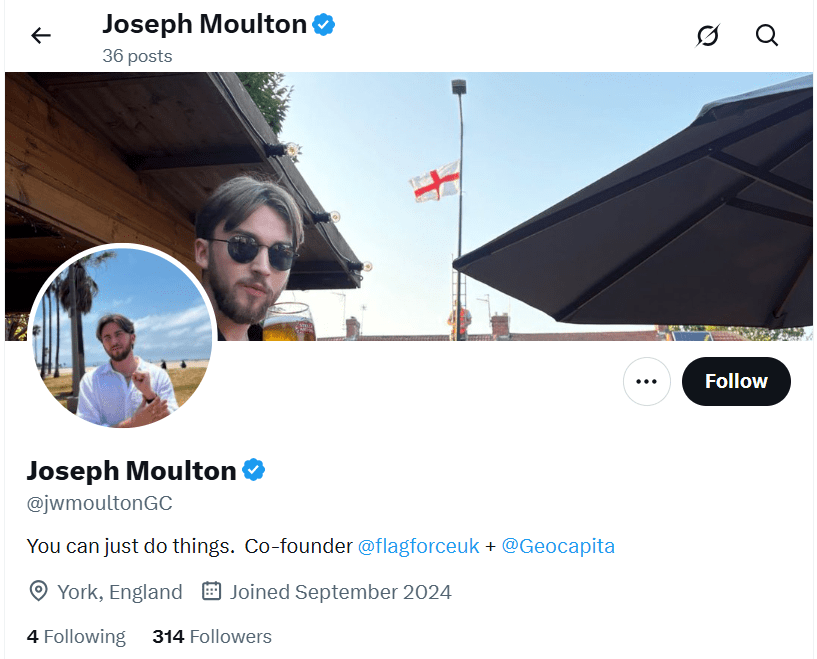
When a 22-year-old presents himself as a seasoned business consultant with international defence sector links, eyebrows are bound to rise. That is precisely the case with Joseph Moulton, the frontman of the UK’s flag-waving initiative known as Flag Force UK.
While the campaign has been marketed as a grass roots patriotic movement, investigations suggest that its leadership and finances are far more opaque. Moulton himself, with his improbable CV and unverified corporate interests, sits at the centre of this intrigue.
A consultant at 16?
According to his own LinkedIn profile, Moulton claims to have begun work as a self-employed business consultant in March 2019. Simple arithmetic makes this remarkable: given his current age of 22, he would have been just 16 at the time. Consulting, as a profession, usually demands significant experience, contacts, or advanced education. Moulton has no public record of university study.

The revelation casts doubt over his broader claims of having advised “Fortune 500 companies and state actors in the defence and supply chain sectors.” While there is no public evidence disproving these assertions, there is equally no independent verification to support them.
In the context of Moulton’s high-profile role in a national influence campaign, such gaps in the record matter.
News outlets have already raised concerns. TRT World, in its investigation of Flag Force UK, questioned whether Moulton could be regarded as a “typical local activist.”
His supposed international business connections appeared too polished for someone leading flag-waving in provincial British towns. Discovering that his claimed expertise dates back to his mid-teens only deepens those doubts.
The Geocapita and Oberion puzzle
Moulton’s online profiles reference two main entities. The first is Geocapita, originally described as a London-based think-tank advising world leaders on intelligence but now described as a “non-profit think-tank with charitable status dedicated to providing unique and informed perspectives on global trade, resources and relations”.
The second is the Oberion Group – a defence and data intelligence firm – until recently based in Cyprus but only since July 2025 appearing in UK Companies House records with assets amounting to a mere £2.00.
The lack of transparency makes it impossible to verify their real financial standing, activities, or staffing.
A further piece in this puzzle is provided by another company associated with Moulton which was registered in Cyprus in January of this year. Nampyong Ltd (not to be confused with a UK restaurant business of the same name) lists Moulton as Director and, rather strangely, Cyproservus Co Ltd as ‘secretary’.
The latter is a company appearing in the International Consortium of Investigative Journalists Offshore Leaks database, with online searches revealing zero about the company in terms of both finances and nature of business.
Unsubstantiated claims
Geocapita meanwhile elevates itself to an even higher level in terms of influence. On its current Linkedin page it describes itself grandly as, “… founded by individuals with experience working with senior leaders in governance and industry, from presidents to CEOs, allowing all our pieces to synthesise perspectives on policy and commercial aspects and provide resolute conclusions to its readers.”
Curiouser and curiouser.
The result of all this is a set of unsubstantiated corporate claims standing alongside extraordinary professional boasts. If Geocapita and Oberion are operating as serious international firms, no significant public data confirms it.
Instead, the impression is of an inflated profile crafted to add credibility to Moulton’s public role.
Flags and influence
The wider Flag Force UK initiative, along with its sister campaign Operation Raise the Colours, has been described as a coordinated influence campaign rather than a spontaneous movement.
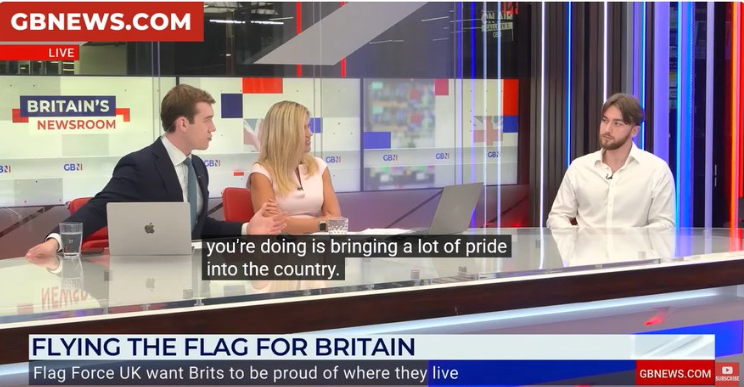
Connections however have been documented to far-right networks, including Britain First whose leader Paul Golding openly stated that they supplied hundreds of flags and funds to local teams participating in the effort.
Crowdfunding has also been used, sometimes raising tens of thousands of pounds for flag-raising activities.
But it is doubtful that whether small donations alone explain the scale of the campaign.
The opaque financial structures surrounding Moulton and his associates reinforce the suspicion that undisclosed sources of money may be at work.
Elon Musk’s shadow
The most eye-catching claim concerns billionaire Elon Musk. In August 2025 reports appeared in certain quarters that Musk was in conversation with Tommy Robinson and others regarding funding Operation Raise the Colours. This remains unconfirmed.
Musk has previously denied donating to Reform UK, despite speculation, but has shown sympathy for elements of the British far right, most recently for Tommy Robinson and Advance UK’s Ben Habib.

Through his ownership of X, Musk has amplified flag campaign content. He has shared videos of flag-lined streets, urging Britons to “fight” before it is “too late.” He has also defended Tommy Robinson and repeated discredited allegations around grooming gangs, prompting concerns about misinformation.
On Saturday he appeared, via video link, at Robinson’s London ‘Uniting The Kingdom’ rally.
Whether Musk has offered money is unverified, but his social media megaphone has undeniably boosted the campaign’s profile.
Financial opacity
Moulton’s professional persona sits uncomfortably alongside the financial structures linked to his network. Initial research notes hybrid onshore/offshore arrangements, with connections to jurisdictions like Cyprus and Dubai.
Offshore companies are not illegal, and many legitimate firms use them. Yet, to financial investigators, they are red flags when combined with opaque ownership and political activism.
The link to Cyproservus Co. Ltd, a company appearing in the ICIJ Offshore Leaks database, illustrates the point. While no illegality is alleged, the association underscores the secrecy of the network.

Such arrangements can make it nearly impossible to determine who ultimately controls or funds the businesses. For someone presenting as a grassroots community organiser, the contrast is stark.
Avoiding scrutiny
The contradictions in Joseph Moulton’s story are not just about personal exaggeration. They go to the credibility of a campaign that has sought to wrap itself in the Union Flag while avoiding scrutiny of the campaign’s origins.
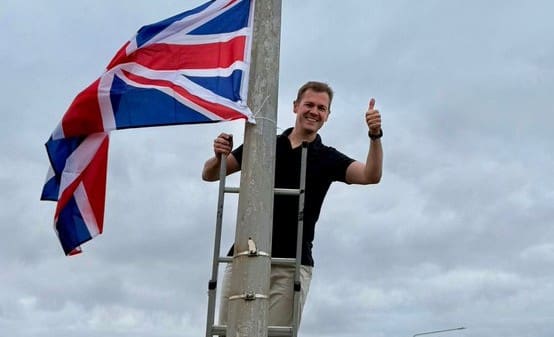
If Moulton is merely a polished front for deeper, better-resourced networks, the claim that Flag Force UK represents ordinary people becomes harder to sustain.
What is clear is that:
- His business claims remain unverified by independent evidence.
- His supposed consulting career began implausibly at 16.
- His named companies lack fully transparent public records in the UK.
- His network operates with the financial hallmarks of influence campaigns.
None of this is evidence, let alone proof, of illegality. But it paints a picture of a leader whose CV and financial base are more smoke and mirrors than grass roots foundations.
Unanswered questions
Joseph Moulton’s curious case is emblematic of a wider trend in the far right: the use of youthful, media-friendly figures with glossy online biographies to front movements that are neither spontaneous nor transparent.
The flags may flutter on high streets across Britain, but behind them lie unanswered questions about funding, corporate structures and credibility.
Until Moulton’s business record is fully substantiated, and the backers of the flag campaign revealed, the safest conclusion is that this is less a patriotic groundswell and more an orchestrated exercise in influence with Joseph Moulton as an improbable figurehead.