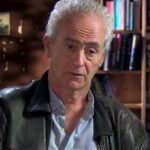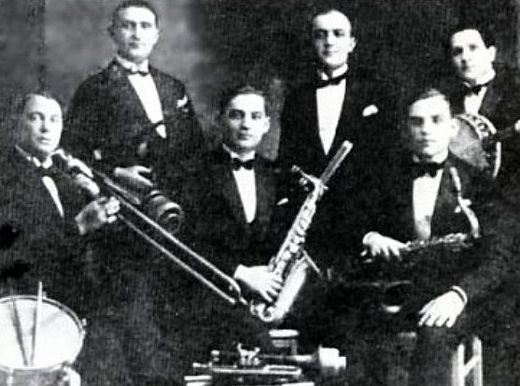
In the summer of 2013 I interviewed Samuel Willenberg, at the time the last surviving participant of the Jewish revolt at Treblinka, the Nazi death camp in Eastern Poland. During the interview, he reminisced about Artur Gold, the famous Jewish violinist, and leader of the Treblinka orchestra.
He told me: “As we stood during evening roll call, Gold and the musicians played, tears flowed down my cheeks. I thought to myself, ‘How was it possible in this hell to hear such beauty?’”
The smells of flesh and bones
Another Jewish survivor, Oscar Strawczinsk, also recalled the role of Gold’s orchestra in Treblinka in his testimony recorded after the war. He said:
“After supper [the orchestra] plays music in the tailor shop, the largest and nicest hall in the ‘ghetto’.
“The sky over and around the camp is red from the fire burning in the tremendous oven that was built lately, and the wind brings the smells of flesh and charred bones… in the tailor shop, our ‘aristocracy’ has gathered (kapos, and prisoners with positions of authority) with their girls.
“Germans and Ukrainians also appear. The girls and our “cavaliers” dance to the rhythm of the wonderful sounds of Gold’s orchestra … this was a daily event in Treblinka”.
A musical legacy
Artur Gold was born in 1897 in Warsaw. Poland. He came from a family of musicians; his father Michal Gold was a flautist in the Warsaw Opera and his mother Helena was a skilled melodist.
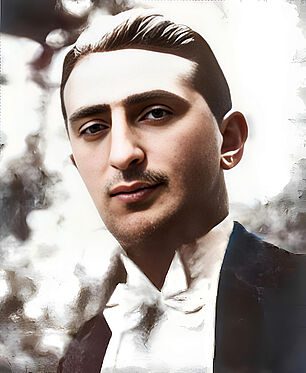
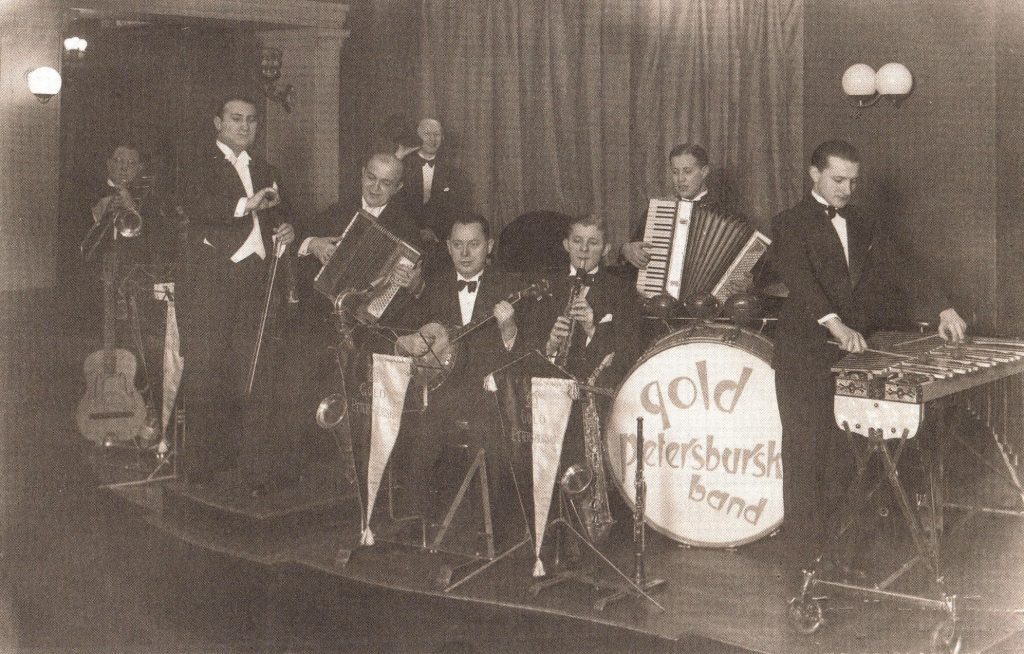
Artur played the violin. In his early 20s he studied music in London and performed in several orchestras, and in 1922 he established a jazz band with his cousin Jerzy Petersbuski and recorded songs for Columbia Records and Polish Odeon Records.
In 1929 he returned to Warsaw and was a very successful violinist, composer and band leader. Along with his brothers, Adam and Henryk, he performed at the famous “Adria” and “Qui Pro Quo” theatres in Warsaw.

Songs like Nie odchodź ode mnie (Don’t walk away from me), Nie wierzę ci (“I don’t trust you} and probably his most famous, the tango, Jesienne Róźe (Autumn Roses) made him one of the most popular band leaders and composers in Poland.
Music and life in the Warsaw Ghetto
The Nazis invaded Poland on 1 September 1939, and within weeks they began to systematically remove Jewish people’s rights and start the process of isolating Poland’s 1 million Jews from the rest of Polish society.
Like every Jewish inhabitant of Warsaw and its surrounding area, Artur was forced by the Nazis to move into the city’s Ghetto in 1940.
The Ghetto was closed to the outside world on 15 November 1940. It was overseen by Nazi commissioners including Ludwig Fischer, and Hans Frank.
Ghetto police
The Nazis appointed a Judenrat (Jewish Council), under the leadership of Adam Czerniaków, which was responsible for maintaining the Ghetto and employing the infamous Jewish Ghetto police.
The Warsaw Ghetto was a place of unimageable cruelty and despair. Surrounded by a 3-metre-high wall and patrolled by ruthless Nazi guards it was a giant prison camp.
Any Jewish person found outside the Ghetto walls was summarily executed by the Nazis. Covering 1.3 square miles, the Ghetto housed as many as 460,000 Jews.
Approximately 80,000 Ghetto inhabitants worked in its factories as slave labourers. The rest of the Ghetto population fared even worse and had to survive by any means they could.
Starvation and disease
Overcrowding was a major issue, there were on average 9.2 people per room and inhabitants were forced to live on starvation rations (189 calories a day). In the Ghetto’s two-and-a-half-year existence at least 90,000 people died of starvation and related diseases.
Around 80 percent of all the Ghetto’s food was acquired by smugglers, often young children, who took huge risks trying to obtain food in the Polish section of the city.
Around 95 percent of the inhabitants of the Warsaw Ghetto lived in abject poverty, however according to the historian Israel Gutman, there also existed a rich subclass of around 20,000 inhabitants. Their wealth enabled them to obtain luxury foodstuffs and goods on the black-market.
Dining in luxury
This social class included industrialists, high ranking Jewish officials, members of the Jewish Ghetto police and professional smugglers.
While death and disease stalked the streets, the wealthy inhabitants were able to dine in luxury restaurants (there were at least four in the Ghetto) and dance and drink in its night clubs.

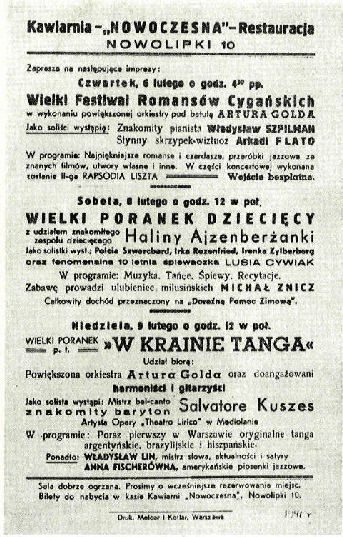
When Artur arrived in the Ghetto his reputation as a band leader enabled him to gain employment as a musician. He regularly performed at the Nowoczesna Cafe (see image) on Nowolipki Street.
Interestingly the café was just a few doors down from the spot Emanuel Ringelblum hid part of the Oneg Shabbat Archive.
Another famous musician who performed at Nowoczesna Café was Władysław Szpilman, who was famously portrayed in the film “The Pianist”. In his memoirs he recalls how the Cafe’s patrons ignored his playing in order to conduct business deals.
The Treblinka hell
Operation Reinhard was the code name of the secret Nazi plan to exterminate all Polish Jews. Three killing centres were constructed in Belzec, Sobibor and Treblinka and operated between 142 and 1943.
Approximately two million Jewish people and tens of thousands of Poles, Roma (Gypsies) and Soviet POW were murdered. It was the deadliest phase of the Holocaust.
The destruction of the Warsaw Ghetto, known as the Grossaktion began on 23 July 1942 and temporarily stopped on 21 September 1942. Approximately 265,000 Jewish people were deported by train to Treblinka. The vast majority were gassed to death within hours of arriving at the camp.
Treblinka’s SS guards also made the orchestra play near the gas chambers to drown out the screams of those being murdered. Several of the surviving camp inmates state that the orchestra played a song they called ‘Death Tango’.
From its earliest days there was a camp music trio at Treblinka that would play during mealtimes and at special occasions. Every camp apart from Chelmno had an orchestra.
Several survivors and Nazi guards claim that Kurt Frank (Treblinka’s Nazi deputy commander) decided that the trio was “not good enough” for his camp and so he set about creating a new camp orchestra.
Deported to Treblinka
Any Jewish professional musicians that were found on the transports was removed and became part of this orchestra. Artur survived the Grossaktion and remained in the Ghetto, but some point in late 1942 he was rounded up and deported to Treblinka.
According to the historian, Yitzhak Arad, Artur was already naked and, in a line, to enter the gas chamber before Frank discovered his presence. Frank removed Artur from the line and gave him the task of organising the camp orchestra.
Boasting
Frank even travelled to Warsaw to obtain some of Artur’s records. He took great pleasure in having such a well-known orchestra leader at Treblinka. One guard interviewed after the war stated that Frank liked to boast about it to officers at the other death camps.
The orchestra consisted of ten musicians, and a male and female choir were also recruited. The members of the orchestra were excused from work duties and given extra rations.
The orchestra performed in special blue and white uniforms with bow ties. However, Frank’s support for the orchestra was superficial, on occasions he mocked the orchestra members; he would make Artur dress as a clown and allowed SS guards to abuse the musicians at camp parties.
The ‘Death Tango’
Frank instructed Artur to compose a marching song for all inmates to sing during evening roll call and on their way to and from work. Artur’s song was nicknamed The Treblinka Anthem by the camp inmates (see below).
Treblinka’s SS guards also made the orchestra play near the gas chambers to drown out the screams of those being murdered. Several of the surviving camp inmates state that the orchestra played a song they called “Death Tango”.
Interviewing Samuel I discovered the song was in fact Jesienne Róźe (Autumn Roses). You can hear it here:
Artur and his orchestra had a big impact on both the camp inmates and the Nazi guards. Most survivors’ testimonies mention Artur. But their views are mixed. Some claim that the music provided much needed moments of beauty and tranquillity.
Other survivors disliked Artur, saying they were “revolted by the orchestra” and what they saw as its role in enabling the Nazis to carry out their murderous operations.
The Anthem of Treblinka
We look straight out at the world
The columns are marching off to their work
All we have left is Treblinka
It is our destiny
We heed the commandant’s voice
Obeying his every nod and sign
We march alone together
To do what duty demands
Work, obedience, and duty
Must be our whole existence
Until we, too, will catch a glimpse at last
Of a modest bit of luck
On the 2 August 1943 an extraordinary event took place. Camp inmates at Treblinka organised a heroic revolt. During the uprising they destroyed part of the camp’s infrastructure and killed or injured at least seven camp guards.
All the known survivors have left their testimonies which can be found at the USC Shoah Foundation Visual Archive.

Of the 840 prisoners who took part around 400 were killed and over 300 escaped. 100 of these survived the war.
There is no definitive agreement as to what happened to Artur, some survivors said he was murdered by the Nazis shortly before the Treblinka Uprising, others stated that he was killed during the revolt.

But one thing is certain. If the revolt had not taken place at Treblinka the world would not know about the crimes committed in that hell and the stories of the camp’s many victims, including Artur.