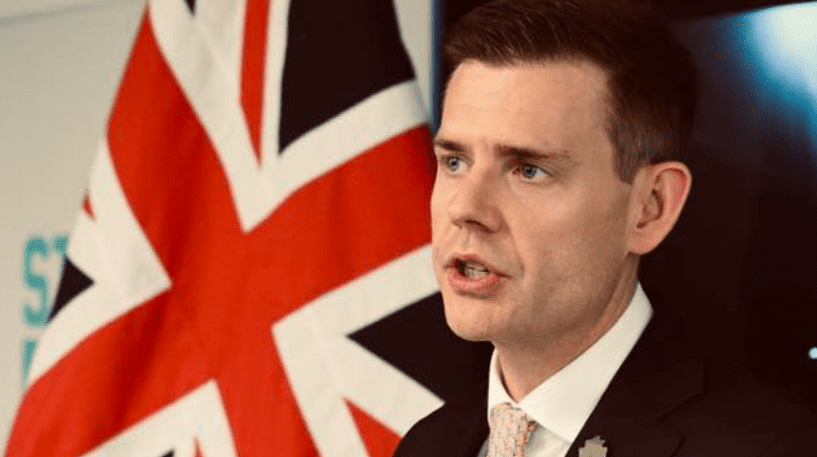
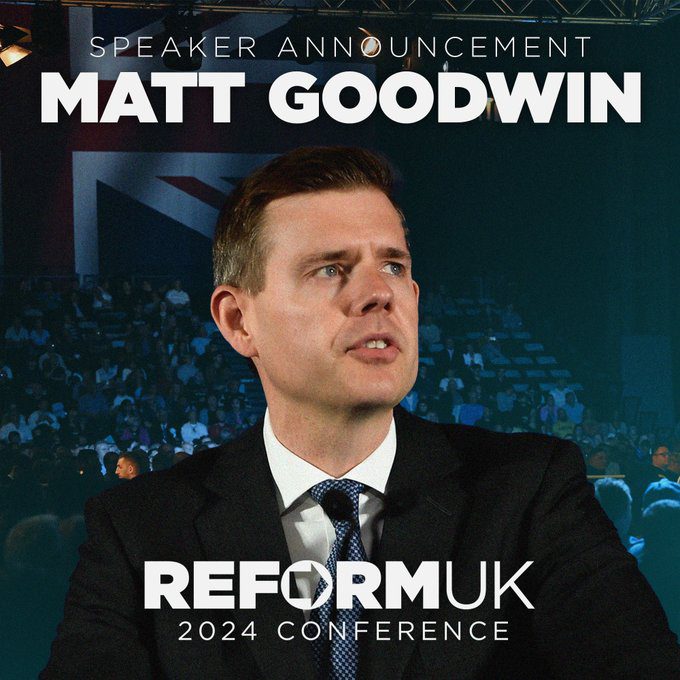
Reform UK’s decision to appoint political scientist Matthew Goodwin as Honorary President of its newly launched student organisation, Students4Reform, marks a significant moment in the party’s evolution.
Announced last week on Goodwin’s own social media and in subsequent press coverage, the move is more than symbolic. It signals Reform’s intent to anchor its youth wing in intellectual credibility, and its national-conservative agenda within university campuses.
‘Unrepresented’ students
Students4Reform is presented as a vehicle for young people who feel excluded by mainstream politics. Its remit includes building campus branches, recruiting members, and offering a voice to students disaffected by cultural and political currents.
While Goodwin will not manage every branch directly, his name confers symbolic power. As a respected academic-turned-commentator, his presence will lend legitimacy to Reform’s messaging and create a bridge between the party’s national agenda and its youth outreach.
From analyst to advocate
Born in 1981, Goodwin built his career as a political scientist specialising in populism, extremism, and right-wing movements. He held posts at Salford, Nottingham, and the University of Kent, leaving academia in July 2024 via voluntary severance.

Since then, he has become a prominent voice on GB News, a prolific Substack writer, and a fixture in national-conservative think-tank circles, notably the Legatum Institute.
His ideological shift is clear. Once an observer of populist trends, Goodwin now advocates openly. He critiques multiculturalism, rails against “woke elites,” and warns of immigration as a destructive force.
His language around national identity often implies cultural gatekeeping. One widely reported remark encapsulates this: “Just because you are born in Britain does not automatically make you British.”
Russia, Putin, and ‘realism’
Goodwin’s foreign-policy commentary adds another dimension. He frames Russia and Vladimir Putin through a ‘realist’ lens, arguing NATO and Western elites bear responsibility for provoking Moscow into its war with Ukraine.
While professing a personal dislike of Putin, he has nevertheless described him as an “admirable political operator.” His analysis minimises any ideological threat, portraying Russia as opportunistic rather than ideological.
For young audiences, this framing can be attractive: pragmatic, less morally dogmatic, and more accommodating of authoritarian power.

Yet it risks normalising an admiration for strongmen, blurring the line between ‘realist’ analysis and ideological affinity.
Legatum connections
Goodwin’s close association with the Legatum Institute adds to the significance of his new role. The Institute is funded by the Legatum Foundation, itself controlled by Christopher Chandler and his partners at the Legatum Group.

Legatum’s reach extends beyond the think-tank sphere. The investment firm holds a controlling interest in GB News, the channel on which Goodwin frequently appears.
This convergence of media ownership, ideological sponsorship, and historic Russian financial connections does not amount to proof of malign influence.
Yet it creates what some describe as an “authoritarian-adjacent” milieu: a space where nationalist-leaning arguments can flourish, supported by institutional prestige and broadcast reach. Goodwin is a prominent voice within that ecosystem.
Implications
The implications of Students4Reform may be considerable. Goodwin’s intellectual framing provides cover for harder-right political factions within Reform UK, offering a soft ideological base that could accommodate authoritarian regimes, particularly Russia.

The youth wing may recruit students not only through cultural nationalism but also via a foreign-policy ‘realism’ that portrays Western values as weak or transactional.
Unlike overtly extremist groups, this network is harder to delegitimise. Its grounding in think-tank infrastructure, academic credentials, and media capital gives it a sanitised respectability, presenting radical ideas in a polished form.
Over time, Students4Reform could become more than a domestic political project: it may evolve into a training ground for activists who connect culture-war nationalism at home with a more accommodating stance towards authoritarian powers abroad.
Prevent Duty
Although Students4Reform is not classified as an extremist organisation, several of its features align with indicators identified under the UK’s Prevent duty.
Narratives of cultural loss, betrayal by elites, and silenced dissent are central to its recruitment strategy, and Prevent guidance highlights grievance-framing as a vulnerability factor for young people.
The emphasis on contested notions of “true Britishness” fosters identity-based polarisation, while the overlap with online radical subcultures creates pathways into more extreme environments. Goodwin’s academic authority can amplify these risks, providing intellectual cover for exclusionary arguments.
Not cosmetic
Matthew Goodwin’s appointment as Honorary President of Students4Reform is not a cosmetic gesture. It signals Reform UK’s ambition to build a youth organisation rooted in intellectual respectability, grievance politics, and ‘realist’ geopolitics.
Goodwin’s network – spanning academia, think tanks, and media – provides ballast and legitimacy. Students4Reform may become more than a recruitment project: it could forge the next generation of national-conservative activists, shaping both domestic identity politics and foreign-policy visions more open to authoritarian power.
The development is a reminder that radicalisation does not always begin at the extremes.
Sometimes, it begins with the respectable face of intellectual authority.