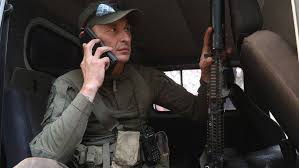
Russian media outlets have confirmed the death, just before Xmas, of Stanislav Orlov, commander of the neo-nazi 88th Reconnaissance and Sabotage Brigade, better known by its original name, Espanyola.
His unit issued a brief acknowledgement but offered nothing on how, where, or why he died.
As far as can be ascertained, however, Orlov was killed on 4 December at his dacha in Russian-occupied Sevastopol, Crimea, shot dead by armed security forces who had surrounded his residence.
It has been reported that they were attempting to arrest him as part of an investigation into into arms trafficking or other criminal charges.
From terraces to trenches
Orlov, known by the call sign Ispanets (“The Spaniard”), rose from Moscow’s CSKA football ultras scene, part of a milieu where football hooliganism, nationalism, and organised violence have long overlapped.
He first fought in Donbas in 2014 and resurfaced in 2022 as a founding figure of Espanyola, created under the Vostok battalion of the self‑declared Donetsk People’s Republic.
The unit drew recruits from extreme-right hooligan football club networks across Russia, including Spartak, Zenit, Torpedo and Lokomotiv, quickly earning notoriety for its open neo‑nazi affiliations.
Military intelligence
Its fighters flaunted “14/88” tattoos and far‑right insignia. By 2023, recruitment ran through the Redut private military company, widely linked to Russia’s military intelligence structures.
A year later, Espanyola was folded into the Defence Ministry’s “Volunteer Corps” and rebranded as the 88th Brigade, a number whose symbolism requires no decoding for Searchlight readers.
Catalogue of atrocities
Espanyola’s record is drenched in violence. In April 2025, the brigade’s Telegram channel declared Ukrainian civilians “legitimate targets”, redefining “peaceful residents” as anyone willing to collaborate with occupying forces. Reports have tied the unit to atrocities in Mariupol, Bakhmut, Avdiivka and Chasiv Yar.
Funding reportedly flowed from a deputy of the ruling United Russia party, illustrating the state’s willingness to bankroll extremist auxiliaries.

Media Investigations exposed how Espanyola used civilian office towers in Moscow City to remotely pilot combat drones into Ukraine. Video clips showed operators boasting that Orlov “hit the target while sitting in Moscow City”.
In October, Espanyola announced its own dissolution and “reset”, promising to re‑emerge as assault and electronic‑warfare units. Orlov’s death weeks later throws that future into doubt.