Germany’s AfD party has again been accused of acting in the interests of Vladimir Putin’s Russia, once more highlighting the convergence of Russian strategic interests and the activities of sections of the European far right.
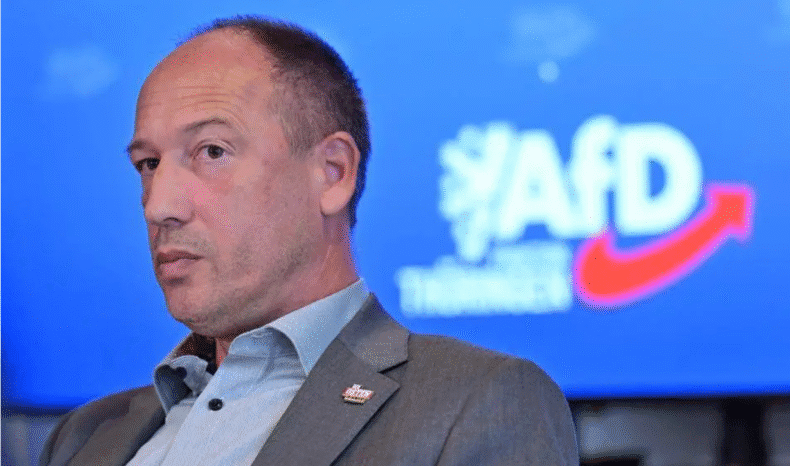
In the eastern German state of Thuringia, Ringo Mühlmann, an AfD member of the local Parliament, has drawn growing criticism for a pattern of parliamentary inquiries that mirror the information priorities of Russian intelligence.
Drone systems
As the AfD has become the strongest party in the regional parliament, Mühlmann has used his legislative privileges to demand detailed disclosures on matters ranging from drone‑defence systems to the movement of Western arms destined for Ukraine.
Inquiries submitted by Mühlmann have probed deeply into operational specifics: the number and type of military transports crossing Thuringia, their routes, and their stopping points; and the technical capabilities of police units tasked with countering hostile drones.
Spy threat
On one day alone, in June, Mühlmann filed eight questions related to drones and the drone defense capabilities of the region’s police, who are responsible for detecting and fending off drones deemed a spy threat.
In September he asked “What information does the state government have about the extent of military transit transports through Thuringia since 2022 (broken down by year, type of transport [road, rail], number of transits, and known stops)?”
Russia aligned
His questions, he insists, are legitimate exercises in democratic oversight. Yet to many in the political mainstream, they appear uncomfortably aligned with the interests of Moscow.
Thuringia’s Interior Minister, Georg Maier, has been among the most outspoken critics arguing that the AfD’s fixation on critical infrastructure and hybrid‑threat preparedness goes far beyond the remit of a regional parliament.
“One cannot help but get the impression that the AfD is working through a list of tasks assigned to it by the Kremlin,” he told German media, noting that geopolitical themes have suddenly become central to AfD questioning in a chamber which has no authority over foreign or defence policy.
Security related
The AfD leadership rejects such accusations, but since 2020, AfD groups in state parliaments have submitted more than 7,000 security‑related questions, far more than any other party.
In Thuringia, the proportion rises to nearly 70 percent.
But whether the AfD acts out of ideological sympathy for the Kremlin or for its own strategic purposes is ultimately secondary.
The effect is the same: a steady stream of inquiries that risks exposing vulnerabilities, undermining national security and abetting Russian intelligence..