


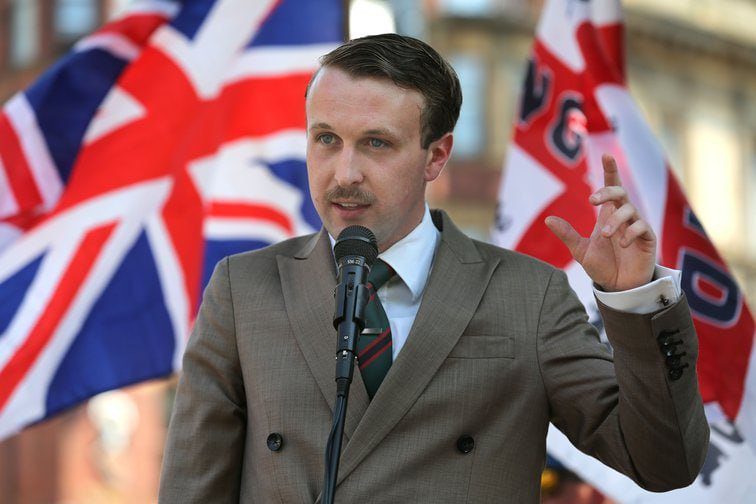

As we approach Brexit’s tenth anniversary, the British far right is still trying to work out how to escape from two long shadows, Nigel Farage and Nick Griffin. Is the future course of British racism to be Farage’s populist imitation of Enoch Powell, or a Griffin-style tribute act based on mid-century fascist dictatorships?
We can be fairly sure that Griffin’s own attempts at a comeback will fail. He is hated too much, by too many serious operators in British fascism.
What is less clear is whether anyone can succeed the BNP as a reasonably serious organisation to the right of Farage – or whether the future lies instead in cultural movements, online networks, or semi-terrorist separatist groups withdrawing from mainstream society.
Searchlight has been closely watching recent efforts to revive something resembling a traditional fascist party. One of the more surprising developments has been an attempt to link younger online nazis with one of the most old-school racist organisations, the British Democrats.
The Brit Dems emerged from the painfully slow break-up of Griffin’s BNP and were launched in 2013. With figures like former MEP and ex-National Front chairman Andrew Brons involved, many anti-fascists assumed they would inherit the BNP’s mantle.
Instead, years of incompetence and ideological infighting left them marginal, with only one or two regional bases.
Ageing veterans
Today the party is led by former BNP councillor Jim Lewthwaite, 74, and has often looked like a social club for ageing BNP veterans in Kent, Essex and outer south-east London.
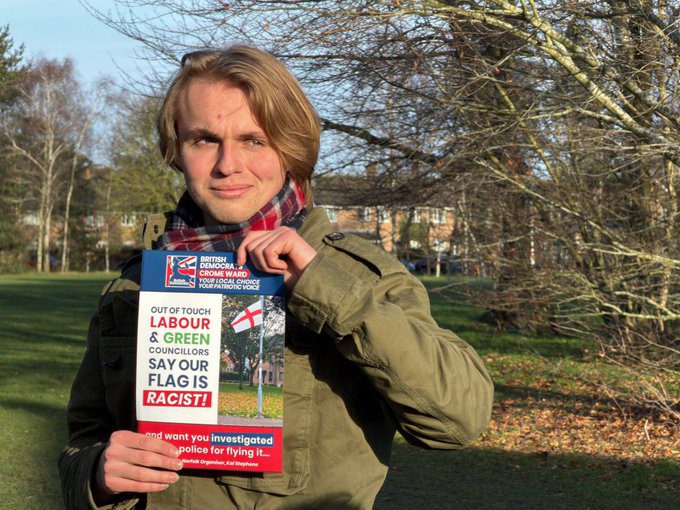
That image has been challenged by their latest highly-publicised recruit, Kai Stephens, leading the advance guard of a younger online racist network.
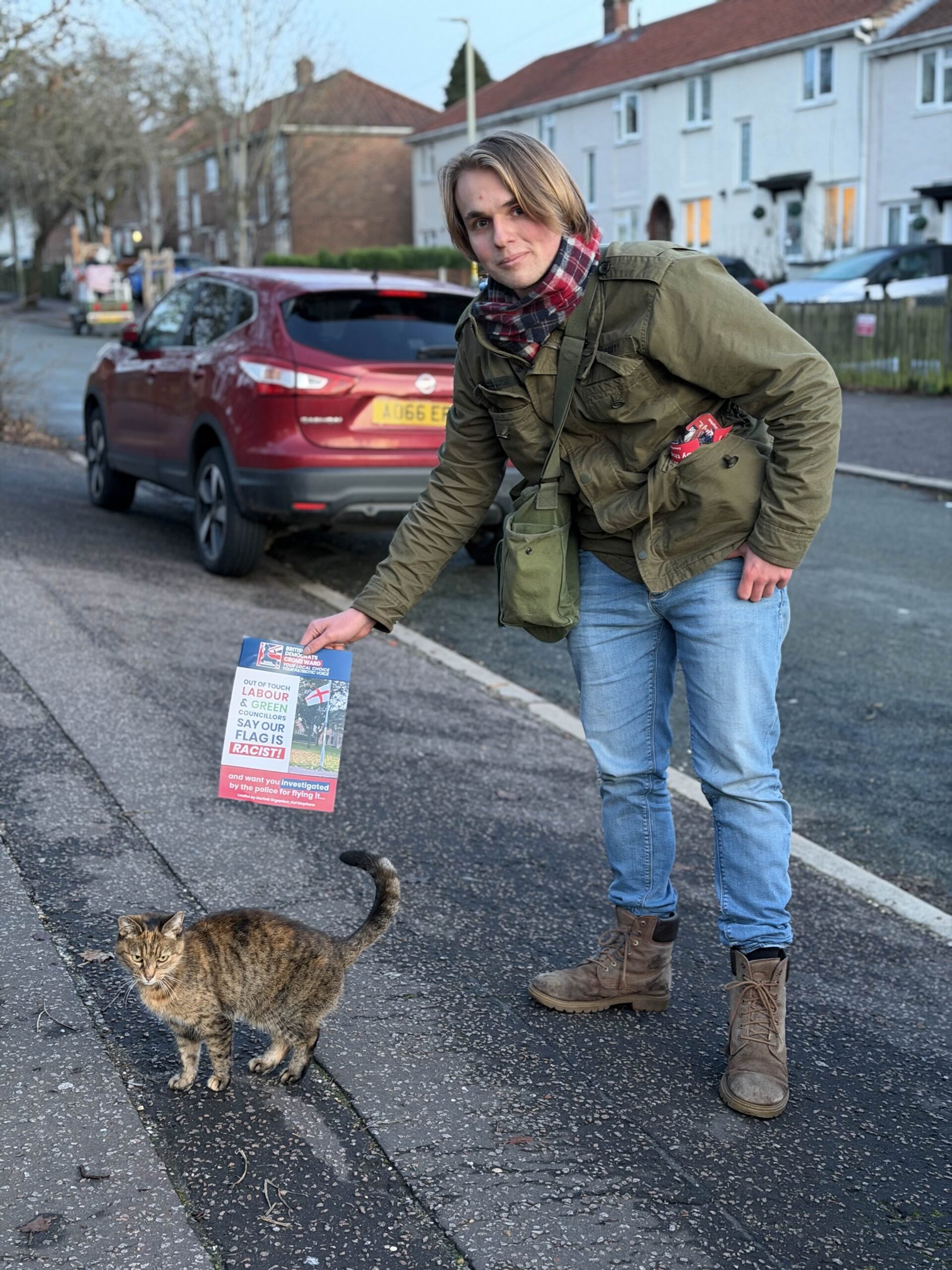
Stephens first appeared as a teenager in Patriotic Alternative under the pseudonym Barkley Walsh, before drifting through successive splits.
He is notorious even on the right, not least for bizarre personal scandals and allegations of online harassment, some of which led to police investigation.
Stephens has now managed the rare feat of involvement in three of the main post-BNP formations: Patriotic Alternative, the Homeland Party and the British Democrats.

After leaving PA, he was among the first to defect to Homeland, swapping loyalty from Mark Collett to another ex-BNP figure, Kenny Smith. Five months ago, the knives were out again, this time for Smith himself.
Homeland’s implosion during 2025 – driven largely by rows over homophobia and online factionalism – made it the year’s biggest loser.
By contrast, the Brit Dems were the clear winners, with modest gains also for Alek Yerbury’s National Rebirth Party and the British Movement. PA remained the largest group, but failed to grow.
Smith’s downfall was triggered by his attempt to ditch obsessive anti-gay politics and present Homeland as a “sensible nationalist” movement, even appointing openly gay officials.
However logical this may have seemed, choosing Northern Ireland as the testing ground was disastrous.
Homophobia
The episode spiralled into ridicule, compounded by embarrassing revelations about the organiser involved, and Smith quickly became the most mocked leader on the UK far right.
Stephens was among those who turned on Smith, despite his own history of personal controversy.
The episode raises questions about whether the August 2025 split was really about homophobia, given that the same critics had no objection when Homeland’s annual conference featured Renaud Camus, the openly gay French ideologue behind the “Great Replacement” theory.

Much of this drama reflects the dominance of online politics. Figures like Stephens, Steve Laws and “Zoomer Historian” Sam Wilkes inhabit a world shaped by X, Telegram and a teenage name-calling culture.
They accused Smith of being a “dinosaur” stuck in leafletting and meetings. Yet Stephens’ move to the Brit Dems – a party barely online at all – suggests his real aim is to engage in “real politics”, learning from the failures of earlier fascist generations.
Infiltration
Strategically, the far right has always faced a choice. Since 1945, some have tried infiltrating mainstream parties, usually the Conservatives. Others have built separate electoral parties, like the National Front in the 1970s or the BNP in the 2000s.
A third approach has been to “shift the Overton window” by influencing ideas and debate and moving rightwards the centre of what is deemed generally acceptable, a strategy perfected by Thatcherite think tanks and later absorbed into the Brexit project.
Farage phenomenon
The Farage phenomenon is a hybrid of all three. Reform acts as a big-tent populist party, challenges the Tories directly, and inherits much of the ideological terrain once occupied by the far right.
This leaves the explicitly nazi-fascist groups arguing over whether Reform blocks their progress or clears the ground for future advances.
Some online activists pin their hopes on figures like Rupert Lowe, imagining a more “patriotic” alternative to Farage. This is fantasy. However far right Lowe drifts, he is unlikely to ally with foam-flecked racists or Holocaust deniers.
Meanwhile, Advance UK – which is appealing to Lowe to join them – has already been colonised by Tommy Robinson, leaving little space for others.
Fascination with weapons
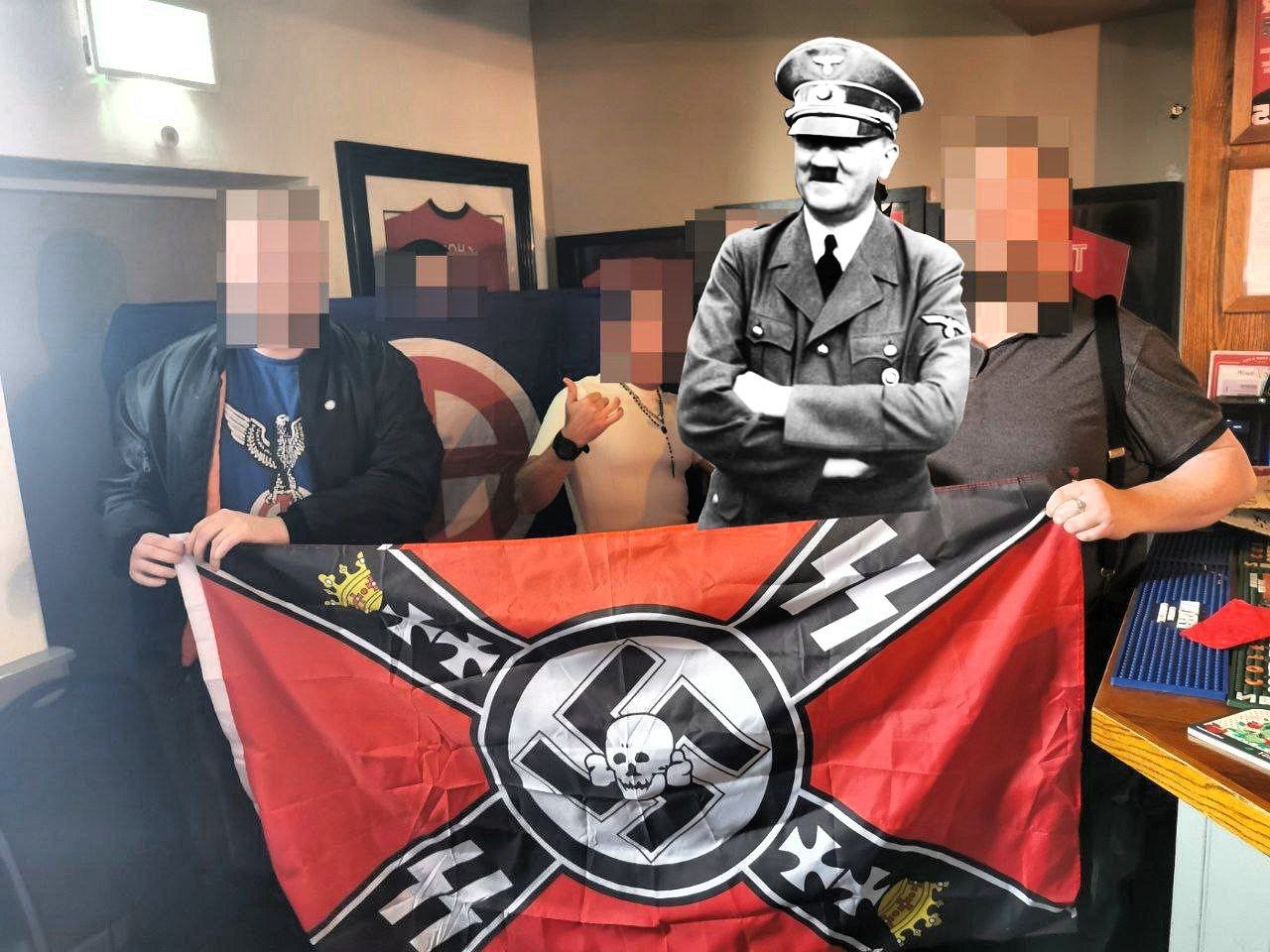
Elsewhere, the British Movement enjoyed a growth spurt in 2025, though its members’ recurring fascination with weapons makes future arrests inevitable.
Its expansion into Northern Ireland is particularly worrying, raising the spectre of violent nazis intersecting with loyalist paramilitarism.
Paul Golding’s Britain First continues to rely on noisy stunts, such as the forthcoming “March for Remigration” in Manchester. These events generate donations and arrests, but no lasting organisation or strategy.
And talking of stunts, last year witnessed the latest chapter in the pathetic decline of UKIP, once a force in the land, into a gaggle of a few dozen noisy, uncouth racists claiming to have reclaimed one town after another from ‘Islamists’, but in reality just providing a living for Chairman Ben Walker.
Significant shifts
It will be tempting, amid an expected surge for Reform in local elections, to write off the traditional fascist right. That would be a mistake.
We believe that small but significant shifts are under way: a boost for the British Democrats, modest growth for the NRP and BM, stagnation for PA, and disaster for Homeland.
Reflecting on the legacy of Gerry Gable, we are reminded why this matters. Time and again, when the far right seemed finished – Mosley, the NF, the BNP – it re-emerged in new guises, often with the same individuals.
That is why even marginal groups must be monitored analysed now, so they can be confronted when they once again crawl out of the margins and threaten democratic values.
This is a shortened version of a report sent to Searchlight’s supporting subscribers