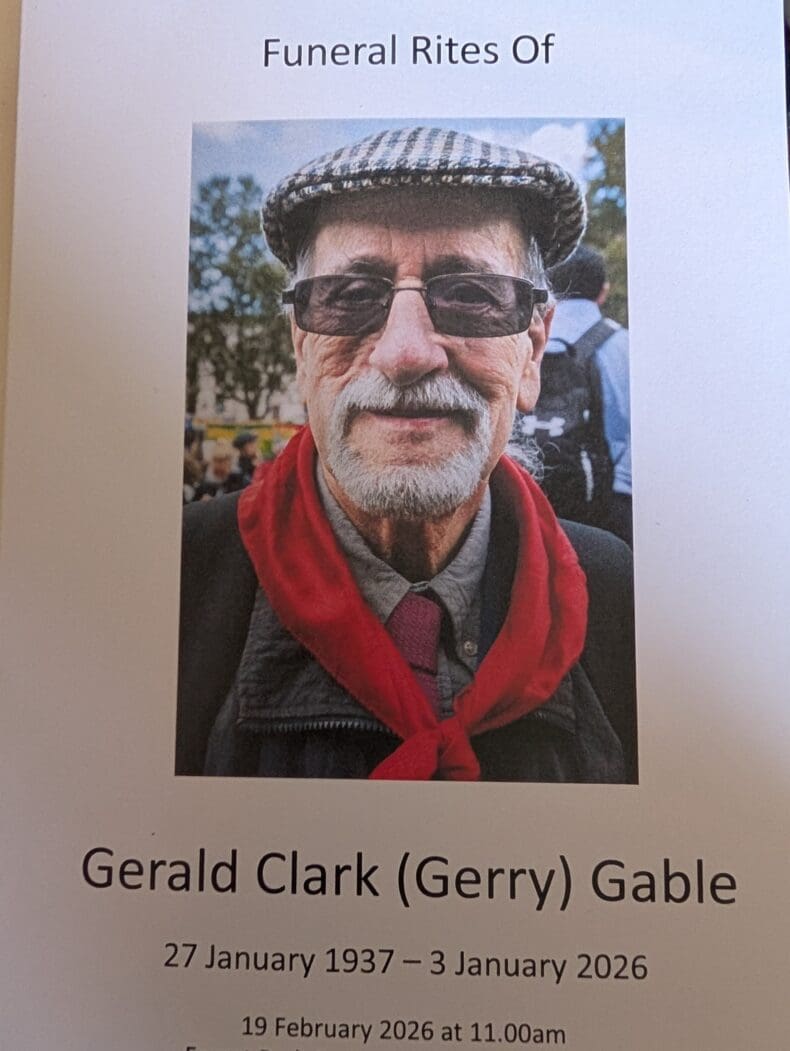
Delivered by Andy Bell at Gerry’s funeral, 19 February 2026
Today, we gather to celebrate the life of an extraordinary man whose courage, tenacity and unwavering commitment to justice shaped the fight against fascism, racism and hatred in Britain and far beyond.
I first met Gerry Gable in 1980, shortly after moving to London. I had already been working with Searchlight in Birmingham for three years, and Maurice Ludmer, the magazine’s editor at the time, had regaled me with stories of Gerry and his comrades – tales of their adventures, their scrapes, and their battles with the fascists.
And, in my mind, I had built up this picture of a tall, dashing, dark‑haired Clark Gable figure.
And then I met him at London Weekend Television, where he was working: a short, slightly tubby chap with bad hair and an even worse moustache.
But as you can see from the funeral card in front of you, he was indeed Clark Gable – and certainly in the ways that really mattered.
I was honoured when he asked me to be his best man when he and Sonia married in 1983, and equally honoured when he stood beside me when I married many years later.
To speak of Gerry Gable is to speak of Searchlight, the anti-fascist project to which he devoted almost his entire adult life and with which he became virtually synonymous.
Gerry Gable was Searchlight and Searchlight was, and in a very real sense remains, Gerry Gable.
Gerry was born in 1937 in East London, into a working‑class family, the son of a Jewish mother and an Anglican father.
From his earliest years, he encountered antisemitism and bigotry. A schoolteacher once singled him out with a slur about his heritage; classmates chased him home with stones.
These were not simply childhood memories. They fuelled a lifetime of resistance to hatred and oppression.
By the age of 15, Gerry was already active in political life. He joined the Young Communist League, worked on the Daily Worker, and later became a trade union organiser in the Communist Party. Though he parted ways with the Party in the 1960s, his commitment to the working class and to the trade union movement never wavered.
In the early 1960s, as fascist groups – from the National Socialist Movement to the Union Movement – tried to re‑establish themselves on British streets, Gerry was among those who rose to meet the challenge.
Alongside other anti‑fascists, he became a leading figure in the 62 Group, a militant organisation, to put it mildly, dedicated to confronting and undermining the emerging far right.
Gerry’s role was central. It was as much about careful intelligence and infiltration as it was about visible protest.
As he would later say, this was “intelligence‑led anti‑fascism”.
Out of this period grew what would become Gerry’s life’s work: Searchlight magazine.
First launched as a newspaper in the mid‑1960s and then relaunched as a magazine in 1975, Searchlight was never just a publication.
It was a network, an organisation, a weapon of truth in the fight against the far right.
Its first major engagement was with the National Front as it emerged in the 1970s as a worrying electoral force. In truth, this was what Searchlight Mark II had been created to confront.
And it played a huge role, supplying local anti‑fascist committees and then the Anti‑Nazi League with the material they needed to deliver devastating blows to the NF’s public image.
Its leaders, who had only recently paraded in Nazi uniforms, were now attempting to reinvent themselves in lounge suits. Searchlight helped expose the reality behind the façade.
Gerry’s partner in those early years was Maurice Ludmer, another truly inspiring figure.
Maurice’s death in 1981, at the appallingly young age of 53, left Gerry to steer the ship alone. But steer it he did, with courage, leadership and an unshakeable belief that the struggle against the far right was, first and foremost, an intelligence war.
There had been, famously, the 62 Group raids on fascist offices, whose haul included membership lists and correspondence records, and most notably revealing snaps of John Tyndall, Martin Webster and other allegedly respectable National-Fronters in Nazi uniform or giving nazi salutes or out on paramilitary manoeuvres.
But such activity had to end once the magazine was established. The infiltrators and informants, however – about whom much has now been written – continued their work. These brave individuals, over decades, handled and guided by Gerry, wrought havoc on the far right, exposing their plans, their crimes and their plots.
One of the most striking episodes, and one of which Gerry was particularly proud, was the foiling of a planned bomb attack on the Notting Hill Carnival in 1981, thanks to information from one of Searchlight’s most notable inside agents, the great Ray Hill, who also became one of Gerry’s dearest friends.
These were the glamorous moments. The “Wild West” or “James Bond” bits, as they’ve been described.
But much of the intelligence work was far more mundane. These were the days before the internet. Fascist publications – valuable sources of what we would now call open‑source intelligence – had to be obtained covertly and pored over week after week.
Local newspaper reports poured in daily from a friendly press‑cuttings service, allowing Searchlight – and Searchlight alone – to build a national picture of far‑right activity and strategy.
The result of all this included the specific wins like stopping the Notting Hill attack, and even bigger wins over the decades.
Amongst the most notable: helping bring down the National Front in the 1970s, and the BNP in the 2000s.
Without Searchlight and Gerry at its helm, the story of the far right in Britain might have been very different.
The internet has changed everything, of course, and today the web is full of dedicated fascist watchers.
But back then, so much of the work was grinding, painstaking and lonely, carried out by Gerry and a loyal team of volunteers and writers, documenting, analysing and exposing the structures and personnel of extremist organisations in the UK and beyond.
The result was not just a magazine but an extraordinary archive. Over the years, Searchlight assembled dossiers on thousands of groups, parties and individuals. That archive – another of Gerry’s great sources of pride – is now housed at the University of Northampton.
Gerry’s life was not without danger. His home was targeted; his family endured torrents of hate mail; he was sent a letter bomb and his house was targeted in an attempted petrol‑bomb attack.
His face pictured in the cross-hairs of a sniper’s viewfinder on Combat 18’s Redwatch hit list was a chilling presentiment of the fate the fascists wished for him
Yet he never backed down.
On one occasion, he was planning to move out of London. Then the National Front discovered and published his address. That was that. “They’ll think I’m running away,” he said. And the house move was cancelled.
Gerry received many honours for his work, but one he particularly cherished was his honorary doctorate from the University of Northampton, home of the Searchlight Archive, a testament to the depth and importance of his decades of research and documentation.
Those who knew Gerry knew a man who was tireless, uncompromising – some would say stubborn – occasionally infuriating, utterly driven and profoundly humane.
These were the qualities that made him such a formidable opponent of intolerance and hatred.
Today, we remember Gerry not only for what he fought against – fascism, racism, antisemitism – but for what he fought for: a society rooted in equality, respect and compassion and, above all, democracy
His influence lives on in the many activists, researchers, journalists and ordinary people who continue the work he helped pioneer.
To his family – to Sonia, his children, his grandchildren, and all who loved him – we offer our heartfelt condolences.
May his spirit rest in peace, and may his legacy remain a blessing and a guiding light for generations to come.