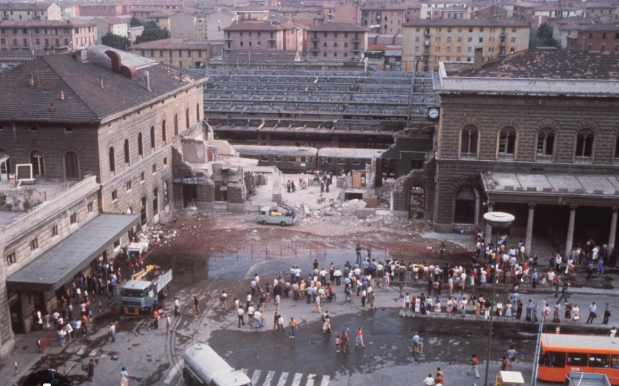
Devastation at Bologna station after the fascist bomb in August 1980
In February 1986, five years after the event, Italian investigating magistrates believed their enquiries had revealed who had been behind the bomb attack on Bologna railway station in August 1980, when 85 people died and over 200 were injured.
They presented a picture of a galaxy of actors, from the wealthy powerful men who planned and financed it, down to the young fascist foot soldiers who carried it out.
This is how Searchlight reported their findings at the time, but also drawing out the links to Roberto Fiore and his fugitive terror cell who had found sanctuary in London.
Bologna accused linked to London terror cell
Bologna magistrates are convinced they have at last solved the mystery behind the bombing of the city’s railway station five years ago. They have now formally charged a long list of individuals with plotting the explosion in August 1980 which killed 85 innocent people and wounded many more.
Amongst those indicted are former top intelligence officers, men linked to the P2 masonic lodge- and terrorist accomplices of the Italian fugitives who have found safe haven in London.
The four investigating magistrates have spent over five years probing the complex conspiracy which they say was behind the attack.
Their indictment reveals a three-tier structure to a well established subversive conspiracy which launched the Bologna outrage as part of a protracted campaign to destabilise and undermine Italy’s democratic republic.
Conspiracy
Leading the plot, they say, were P2 Lodge Grand Master Licio Gelli, his sidekick Francesco Pazienza, and senior intelligence officers Colonel Musimeci of SISMI (military intelligence), General Palumbo, of the Carabinieri’s Pastrango Division, and Colonel Belmonte, also of SISMI. Palumbo died in 1984 and so has not been charged.
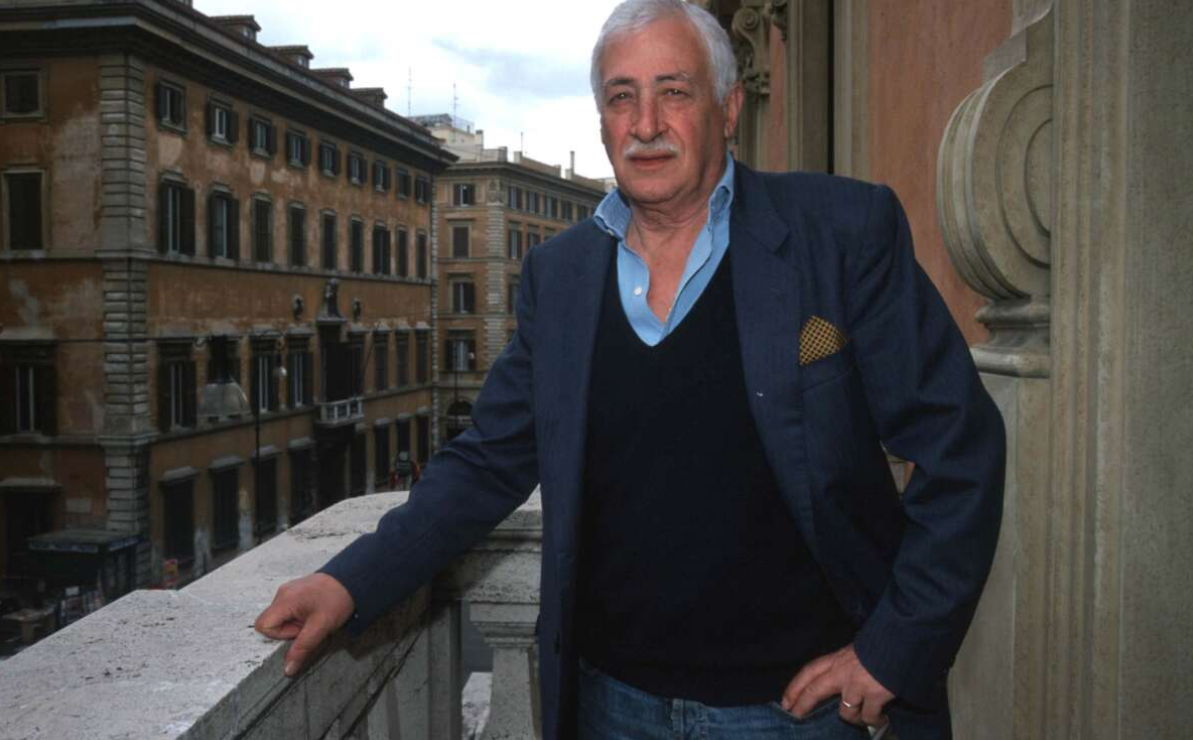
Licio Gelli
It was at this level that decisions about terrorist actions were taken. Such decisions were then communicated down to young neo-fascist footsoldiers through a second level of leading political figures on the extreme right.
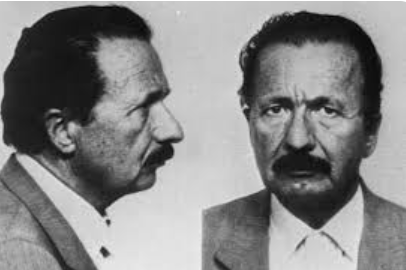
These included Paolo Signorelli, and Aldo Semerari, the founders and ideological leaders of the Third Position Group; Massimiliano Fachini, a leading MSI figure in Padua; and Fabio de Felice, a former MSI deputy who was detained on suspicion immediately after the Bologna attack but later released.
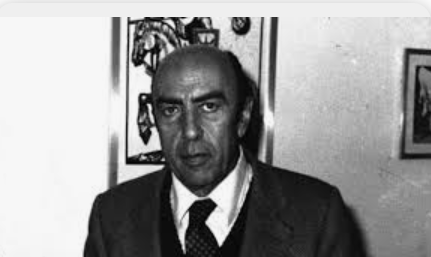
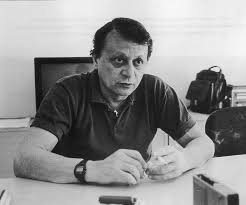
Paolo SignorelliAldo Semerari
Also named is fugitive terrorist Stefano delle Chiaie, who later turned up serving the last military regime in Bolivia under the ‘Butcher of Lyons’ Klaus Barbie.
Stefano delle Chiaie
Semerari was killed in April 1982, in what was believed to be a falling out with the Camorra, the Naples based mafia. His decapitated body was discovered in the boot of an abandoned car.
Carrying out the attacks was what the judges have called a ‘black galaxy’ of young neo-fascist militants, organised into cells of the terror organisation Armed Revolutionary Nuclei (NAR). This, a Rome court recently concluded, was no less than the armed wing of the Third Position, founded by Semerari and Signorelli.
Child star
According to the magistrates, the Bologna operation was undertaken by the NAR cell known as the Cavallini gang.
It was organised by former television child star ‘Guisva’ Fioravanti and Francesco Mambro, who were disguised as Alpine tourists. The explosives (T4 – difficult to obtain in Italy) were delivered by Massimiliano Fachini. Another fascist, Sergio Picciafuoco, was also at the station and was wounded in the blast. In hospital he gave his name as Enrico Vailati.
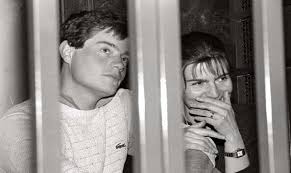
Guisva Fioravanti and Francesca Mambro
Arrested six months afterwards, he was found with a false passport in which his address was given as that of Francesco Mangiameli, an Ordine Nuovo (New Order) member from Palermo. He had sheltered Mambro and Fioravanti only a couple of weeks before the Bologna attack.
A month later, Mangiameli was found shot dead, his body floating in a lake just outside Rome. Mambro and Fioravanti have now been charged with his murder.
Also charged with organising the attack are Gilberto Cavallini (who, with Mambro, murdered investigating judge Mario Amato in June 1980, when they suspected his enquiries were getting uncomfortably close to uncovering the terrorist network), Fabio de Felice, Egidio Giuliani and Roberto Rao.
London link
The NAR cell which is thus accused of carrying out the bombing was closely linked to the group of NAR fugitives currently hiding in London.
Five of these have now been convicted, in absentia, of NAR terrorism, in a trial which included many of the very individuals now charged with Bologna.
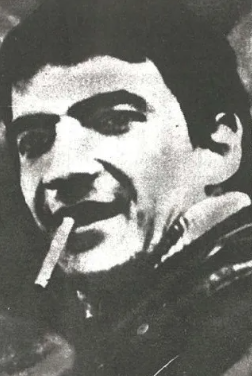
Luciano Petrone
One member of the Cavallini gang, Luciano Petrone, linked up with the London cell led by Roberto Fiore when he fled to England in 1983. He was accused of murdering two policemen and being involved in the massive robbery at the Bank of Andalucia in Marbella, at the end of 1982.
Fiore and other members of the London cell are known to have been Third Position members and, even before that, Fiore himself was a close associate of Mario Tuti, one of the most notorious of Italy’s ‘black terrorists’, in whose ‘honour’ NAR later claimed to have carried out the Bologna attack.
Killer
Another Cavallini gang member was the killer Alessandro Alibrandi, who fled to Britain in 1980 along with Fiore and his cell. With members of Fiore’s group he attended London meetings of the neo-nazi League of St George in early 1981.
Alibrandi was gunned down by police when he returned secretly to Rome after his presence in Britain had been exposed by Searchlight and Granada TV’s World In Action. With Fiore and other NAR members, Alibrandi spent part of 1981 in the Lebanon where he was trained in paramilitary camps run by the right-wing Phalangist militias.
When he was killed, police found evidence that he had been travelling freely between London and Beirut.
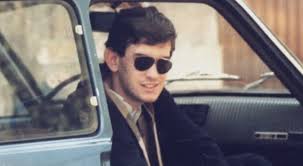
Alessandro Alibrandi
The London cell also sheltered fugitive Serena Depisa who currently faces extradition from the UK. She too was a defendant, along with Cavallini gang members, in the 1985 NAR trial in Rome.
‘Penitent’
Much of the evidence for the Bologna charges comes from the testimony of a growing number of ‘penitent’ fascist terrorists, many of whom are former members of the NAR cells.
The judges have acknowledged the help they have received from Sergio Calore, Paolo Aleandri, Walter Sordi, Mauro Ansaldi, Paolo Stroppiana, Aldo Tisei, Angelo Pizzo, Valerio Viccei, Vincenzo Vinciguerra, Marco Affatigato, Amos Spiazzi, Guido Naldi, Cristiano Fioravanti (‘Guisva’s’ brother) and Nara Lazzarini (Licio Gelli’s secretary).
The fact that the evidence comes not from an individual ‘supergrass’ but from a battery of former conspirators from all three levels, only serves to underline the confidence of the Bologna magistrates that they have at last cracked the case.
Row rumbles on over London cell
Controversy has surrounded the presence in Britain of wanted Italian terrorists since their presence here was first uncovered in 1981. After revelations by Searchlight and World In Action that Roberto Fiore and his NAR cell had taken refuge in London, seven of them were arrested and put on trial for extradition in 1982. They were released after the Italian authorities presented an ill-prepared case.
Ever since, they have been living freely in London, and lending support and assistance to the new Strasserite leaders of the National Front. With a young Front faction espousing openly the politics of the Third Position, the Italians helped engineer the coup that expelled Martin Webster and the remains of the NF old guard two years ago.
Pressure upon the authorities to expel them increased last year after five of the London fugitives were convicted in absentia by a Rome court of NAR terrorist offences. Fiore, Massimo Morsello, his wife Marinella Rita, Amadeo de Francisci and Stefano Tiraboschi were all found guilty of armed conspiracy and given lengthy gaol sentences. Two Home Secretaries, Leon Brittan and Douglas Hurd, have both cited difficulties with EEC freedom of movement regulations in resisting efforts to have them deported back to Italy.
Whilst most of this article still holds true, some things believed to be the case at the time were overtaken by subsequent investigations.
Francesco Pazienza, Pietro Musumeci and Giuseppe Belmonte were not convicted for for “leading the plot”. They were convicted of trying to mislead and divert the investigation.
Those leading the plot have been named as Licio Gelli, Umberto Ortolani, Federico Umberto D’Amato and the Editor of the weekly “Il Borghese” Mario Tedeschi.
Aldo Semerari was not a founder of Terza Posizione, but was a member of the Propaganda Due (P2) masonic lodge, and reputedly maintained links with SISMI the Italian military intelligence agency.
It has now been established that it was not Massimiliano Fachini but Paolo Bellini who delivered the bomb.