
A court in Bari has delivered a landmark judgment against members of the neo‑fascist organisation CasaPound, convicting 12 activists for attempting to reorganise the banned Fascist Party and for their role in a violent assault on anti‑fascist demonstrators.
The ruling is the first time an Italian court has formally recognised CasaPound’s activities as fascist in nature – an important legal threshold in a country where far‑right groups have long operated in the grey zones of post‑war legislation.
Attack on anti-fascists
The case centres on events of 21 September 2018, when a group of CasaPound militants attacked anti‑fascist protesters returning from a demonstration against Matteo Salvini, then interior minister and leader of the League.

The assault took place in Bari’s Libertà district and left several people injured, including former MEP Eleonora Forenza, her assistant Antonio Perillo, and activists Giacomo Petrelli and Claudio Riccio.
The court ordered compensation for all victims, as well as for organisations including the National Association of Italian Partisans (ANPI) and the Communist Refoundation Party.
Prison sentences
Five defendants received prison sentences of 18 months, while seven others were handed two‑and‑a‑half‑year terms after additional assault convictions. All 12 have been barred from holding political office for five years.
Defence lawyers have already announced their intention to appeal, and the court’s full written reasoning is expected within 90 days.
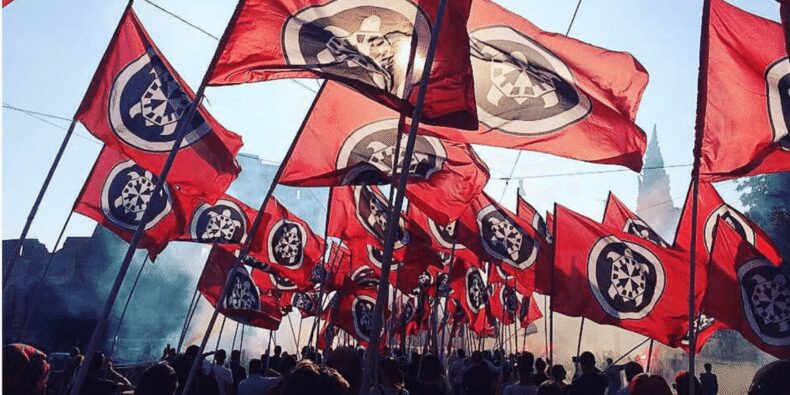
Italy’s 1952 Scelba law prohibits any attempt to reorganise the dissolved Fascist Party and bans fascist demonstrations. Yet prosecutions under the law have been rare, and convictions rarer still.
Courts have often hesitated to classify contemporary far‑right groups as fascist, even when their symbols, rhetoric and street‑level behaviour leave little doubt.
In this case, however, the Bari judges cited clear violations of Articles 1 and 5 of the Scelba law, pointing to the defendants’ participation in “usual fascist demonstrations” and their use of “squadrista methods”—a direct reference to the blackshirt violence of Mussolini’s paramilitaries.
Fascist character
The explicit recognition of CasaPound’s fascist character marks a significant shift in judicial willingness to confront the movement on its own ideological terms.
CasaPound was founded in 2003 when activists occupied a state‑owned building in Rome’s Esquilino district. The group took its name from Ezra Pound, the American modernist poet who broadcast propaganda for Mussolini during the Second World War.
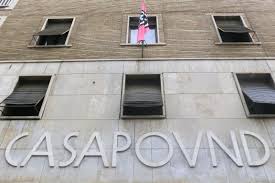
From the outset, CasaPound blended street activism, squatting, cultural initiatives and electoral forays into a hybrid model of far‑right mobilisation.
Despite contesting the 2013 and 2018 parliamentary elections, the organisation never broke the 1% threshold and later withdrew from electoral politics and now presents itself as a “social movement”.
Pressure on Meloni
The Bari ruling has intensified pressure on Prime Minister Giorgia Meloni, whose own political roots lie in the post‑fascist right. Elly Schlein, leader of the centre‑left Democratic Party, has called on the government to dissolve CasaPound entirely, arguing that the court’s decision leaves ministers with “no choice”.
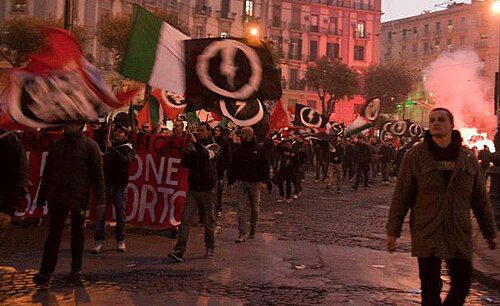
The Five Star Movement and the Greens‑Left Alliance have demanded an urgent parliamentary briefing from Interior Minister Matteo Piantedosi, along with the eviction of CasaPound’s long‑occupied headquarters in Rome.
Piantedosi has previously condemned fascist salutes at CasaPound rallies as incompatible with democratic norms, but he has also insisted that dissolving such groups is legally complex. The Bari ruling may now test that claim.