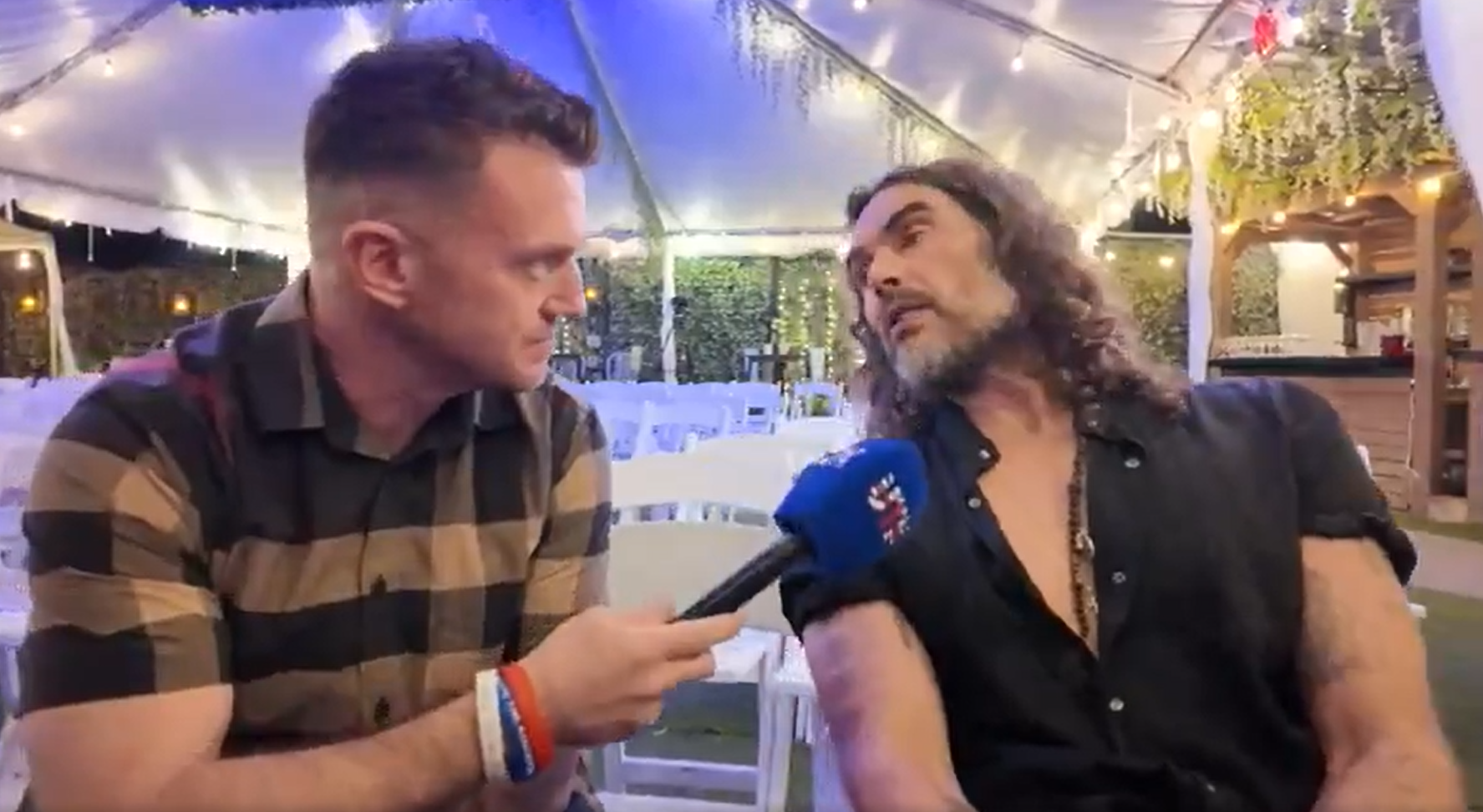
Stephen Yaxley-Lennon, better known as Tommy Robinson, has built a career on weaponising sexual violence allegations against Muslim men. Grooming gang scandals have served as his primary recruiting tool, his fundraising engine, and the moral justification he offers for an ideology rooted in anti-Muslim hatred.
So it is worth pausing to examine what he does when the accused rapist is white, famous, and a useful ally.
In a fawning interview filmed in the United States, Yaxley-Lennon sat down with Russell Brand, who faces multiple charges of rape and sexual assault following allegations first reported by The Sunday Times, The Times, and Channel 4 News in 2023.
No challenge
In the course of the entire interview there was no challenge whatever based on the allegations, no sober acknowledgement that serious accusations had been made, and no suggestion that audiences should treat Brand with any caution.
Instead, Yaxley-Lennon offered nothing but warm admiration: “He’s a brave and bold man,” he told the camera, saluting Brand as someone “paying a higher price” for his beliefs.
The contrast with his treatment of Muslim men facing similar or lesser accusations could scarcely be more stark. Yaxley-Lennon has organised demonstrations, filmed outside courts, and repeatedly named and photographed defendants – actions that, on at least two occasions, almost caused rape trials to collapse. He was convicted of contempt of court as a result
Brand the martyr
He has consistently framed allegations against Muslim men as self-evidently true, demanding immediate consequences. Brand, by contrast, is cast as a martyr.
The interview reveals how Robinson frames this cognitive dissonance. The allegations against Brand, he suggests, are simply part of the establishment’s pattern of “smearing” influential dissidents – a playbook he also extends, in the same interview, to Donald Trump.
Inconveniently, this logic might apply equally to every Muslim man he has ever accused of using false victimhood as cover.
Persecution
Brand himself plays along, using the platform to present his rape allegations as political persecution while proselytising about his Christian conversion. Yaxley-Lennon applauds throughout.
What the interview makes plain is that for Robinson, sexual violence has never really been the issue.
It is, and always has been, a vehicle, useful when the accused is brown, inconvenient when he is not.