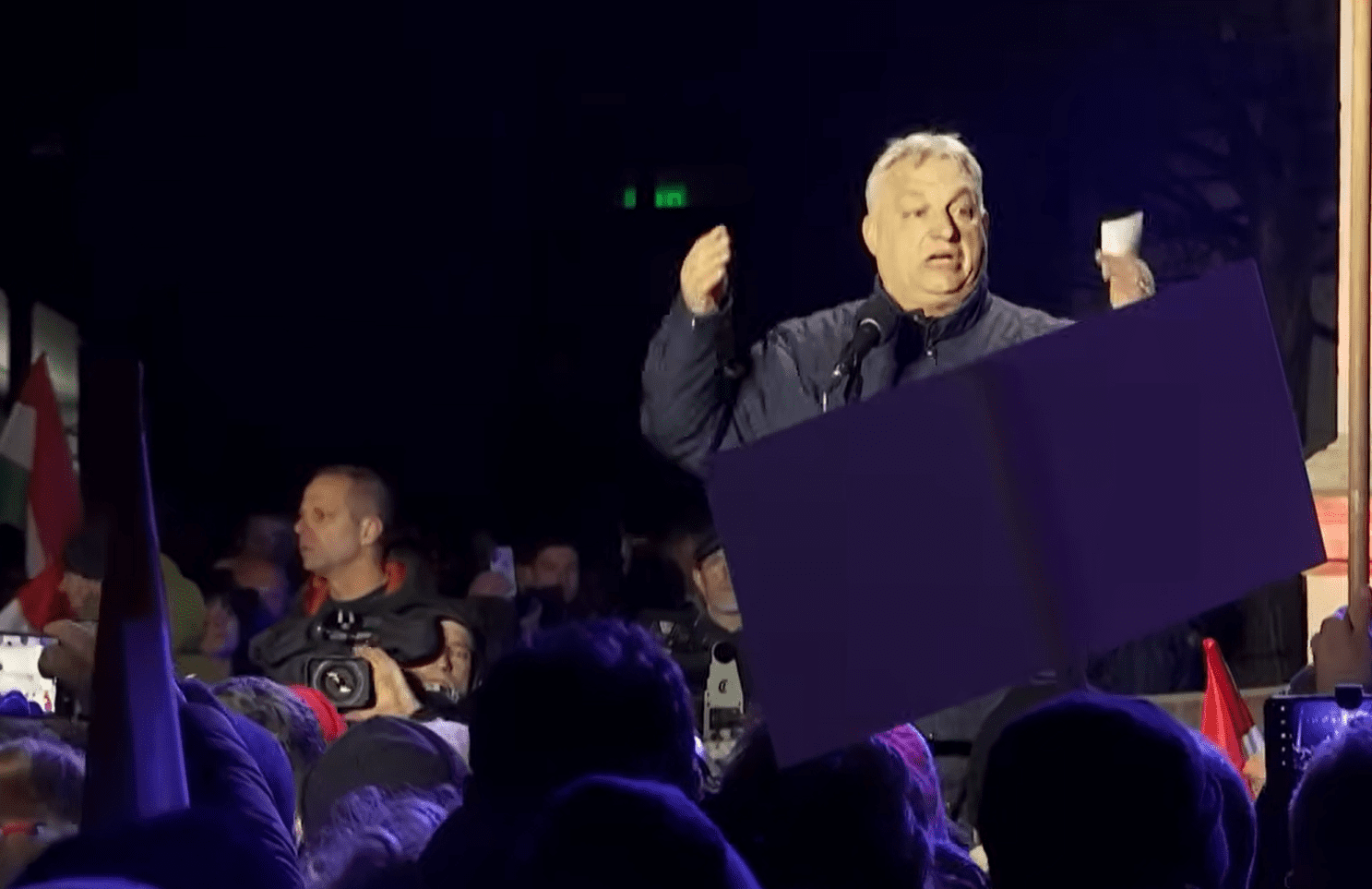
Tomorrow’s Hungarian parliamentary election is being described, with some justification, as the most consequential vote anywhere in the European Union this year. Viktor Orbán, who has held political power for sixteen years since the 2010 parliamentary election, is seeking a fifth consecutive term in office.
The question is whether he will get it and, if he does not, what that means for the transnational far-right project of which he has been the self-appointed architect.
Serious challenge
Orbán’s grip on power is facing its most serious challenge yet, as his right-wing Fidesz party trails the opposition by double digits ahead of the April poll.
The threat is coming from the conservative Tisza party, founded by former Fidesz insider Péter Magyar in 2024, which has struck a chord with Hungarians frustrated by a stagnating economy, a cost-of-living crisis, and corruption.

The numbers are striking. The PolitPro poll trend, which aggregates data from all relevant polling institutes into a weighted average, puts Tisza on 49.1% against Fidesz’s 40.2%, with the far-right Mi Hazánk Movement on 5.2%.
On current projections, Fidesz would secure only 42.7% of parliamentary seats and lose its majority.
Parlous position
If those figures translate into votes it would represent a major reversal. At the 2022 election, Fidesz received the highest vote share by any party or alliance since 1990.
That a party of Orbán’s institutional dominance, which has systematically remodelled Hungary’s judiciary, media and electoral system to its advantage, should find itself in such a parlous position is itself a story.

But the causes are not hard to discern: Hungary now appears to be the poorest state in the EU, behind Bulgaria and Romania. Since 2010, Hungary has lost almost half a million people, both to ageing and to emigration.
Far from being a bulwark against mass immigration and a laboratory of exciting pro-family policies, as imagined by its ideological allies in the West, Fidesz’s policies have served as a catalyst of stagnation and decline.
Outside intereference
The lead-up to Sunday has not been short of incident, and much of it has carried the fingerprints of outside interference.
In March, the Washington Post reported that a unit of Russia’s foreign intelligence service had drawn up a plan to aid Orbán’s campaign as polling showed plummeting public support for him.
His friendly ties to Moscow have long given the Kremlin a strategic foothold inside NATO and the European Union.
Fake assassination
The SVR document, internally named “the Gamechanger,” proposed staging a fake assassination attempt against Orbán, with the aim of shifting the election from the economic terrain, where Orbán is losing, to more emotional concerns about security and national survival.
The plan was obtained and, it is claimed, authenticated by a European intelligence service.
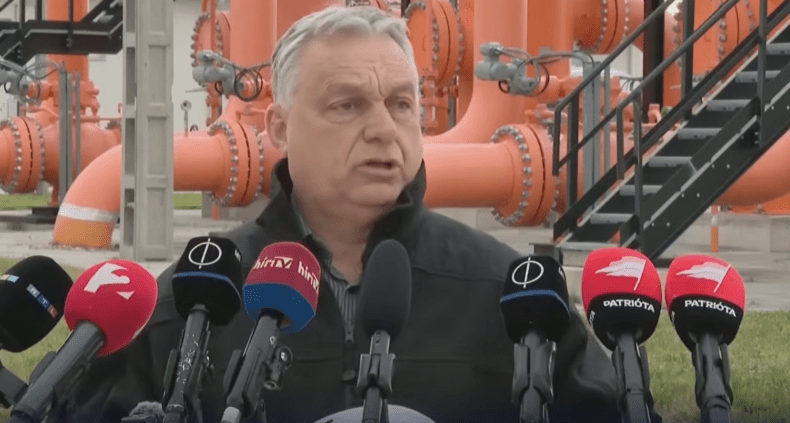
Then, on Easter Sunday, just days before the vote, Serbian president Aleksandar Vučić announced that army and police units had discovered two backpacks containing four kilos of plastic explosive near the village of Velebit in northern Serbia, a few hundred metres from the Balkan Stream pipeline.
This is an extension of Russia’s TurkStream network that carries Russian gas to both Serbia and Hungary.
Orbán hinted that Ukraine might be responsible and convened an emergency meeting of Hungary’s defence council within hours.
Staged provocation
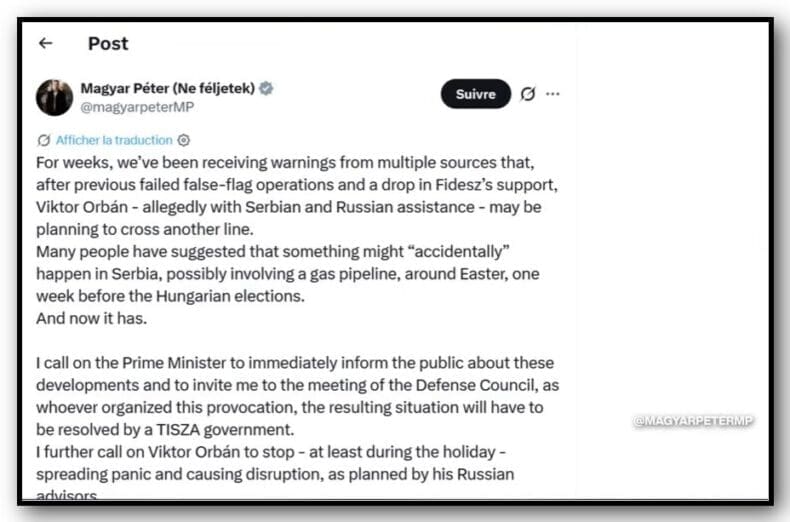
Magyar immediately called the episode a staged provocation, noting that his party had received advance warnings that an incident involving Serbian gas infrastructure might occur around Easter.
What gave that claim credibility was the detail that an analyst had publicly outlined precisely this hypothetical scenario days before it occurred.
A Kremlin-linked operation known as the Social Design Agency, already under US sanctions, has been flooding Hungarian social media with pro-Orbán content while portraying Magyar as a Brussels puppet.
A second Russian operation, Storm-1516, took aim at Magyar personally. Fabricated videos claimed Ukrainian refugees were plotting to assassinate Orbán.
Hope for late surge
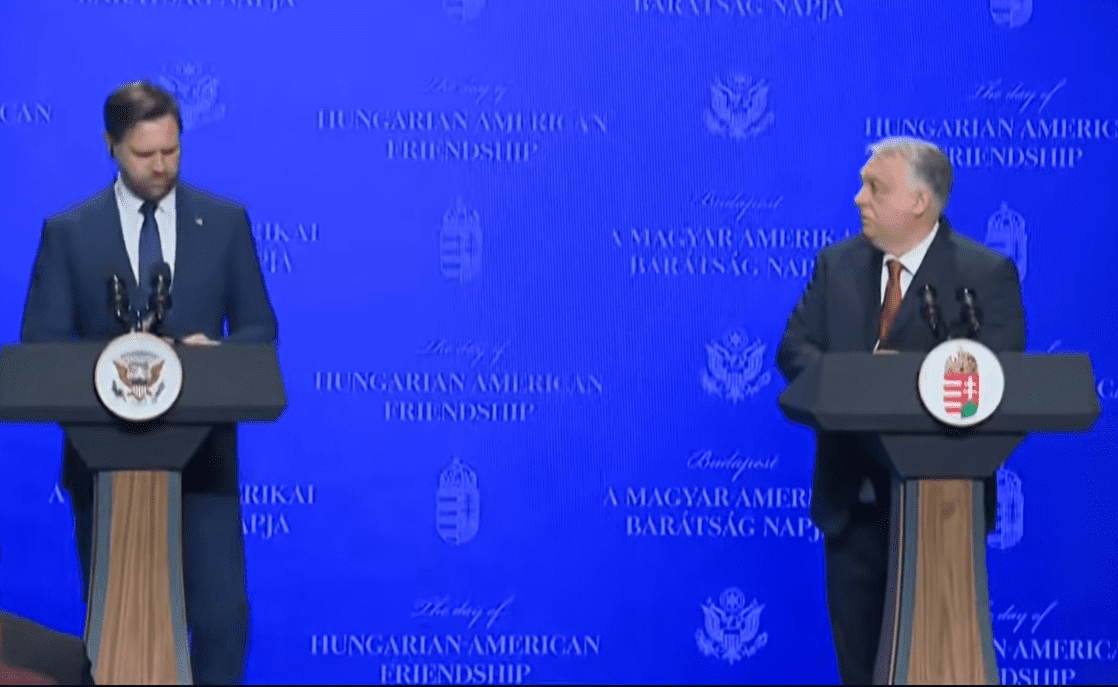
This week, into an already crowded picture, walked US Vice President JD Vance, who arrived in Budapest to support Orbán at a campaign rally, in an unusually public form of US interference in a European election. Orbán had hoped the visit would supply a late surge.
The implications of a Fidesz defeat extend well beyond Budapest. Orbán is not merely a national politician, but the presiding figure of the European far right’s parliamentary infrastructure.
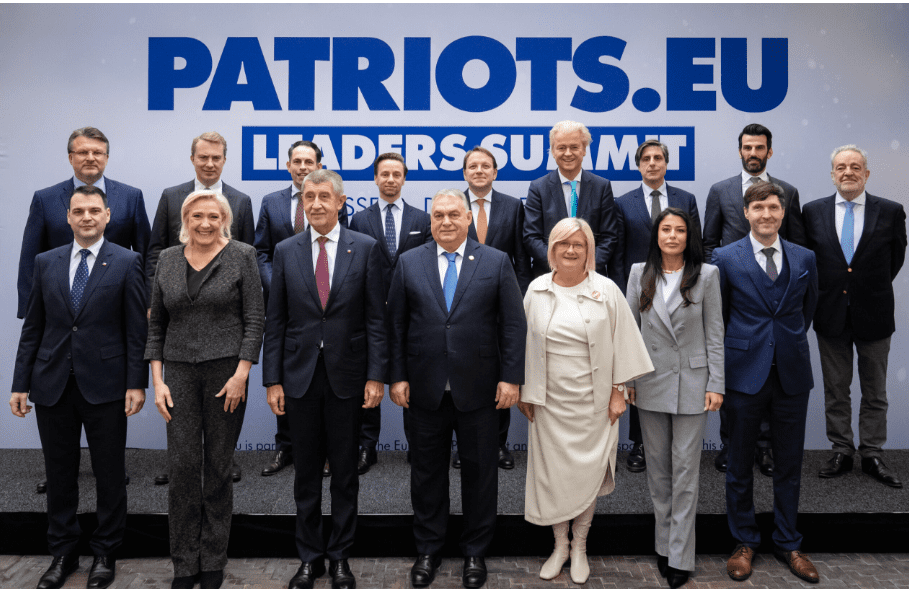
The Patriots for Europe group, which he founded in 2024, is now the third-largest in the European Parliament, with member parties from thirteen EU countries based on opposition to immigration, national sovereignty, and conservative social values.
Transform Brussels
At a Patriots assembly in Budapest in March, figures including Marine Le Pen, Matteo Salvini and Geert Wilders gathered to praise Orbán and urge Hungarians to vote for him, with Le Pen lauding his record on immigration, identity and sovereignty.
The Patriots have rallied under the slogan “Make Europe Great Again” and, as Orbán has told supporters, aim to occupy and transform the centre of Brussels.
Even survival may not restore what Orbán once had. If he scrapes through with a much slimmer majority, he would be a different and potentially more erratic political actor, stripped of the two-thirds parliamentary cushion that has allowed him to reshape the constitution at will.
But even a Fidesz defeat would not be a clean break: the Patriots for Europe will endure in the European Parliament, Le Pen’s National Rally remains France’s dominant opposition force, and Salvini is not going anywhere.
Even if Orbán loses, the forces he helped unleash will not easily be put back in the bottle.