The controversy over Kanye West’s cancelled appearance at Wireless Festival calls to mind the cases of other Black American extremists whose involvement in the UK in the 1980s and 1990s aroused anger. These were political activists happy to forge alliances with organised British fascism.
Two figures stand out: Louis Farrakhan and Osiris Akkebala. Neither will be well known to younger readers. But the activities of both were well-reported in Searchlight many years ago, and both caused serious harm.
Foreign patrons
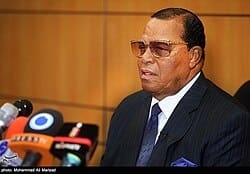
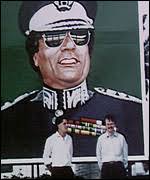
Farrakhan (now 92) is head of the New York based “Nation of Islam”. He was pledged hundreds of millions of dollars by Libyan dictator Muammar Gaddafi – though most of this was blocked by the US government – and during the 1980s this Gaddafi connection led to ties between Farrakhan and Nick Griffin’s “political soldier” faction of the National Front.
A delegation of leading members of the National Front travelled to Libya at the time seeking financial support from Gaddafi.
Then the NF was controlled by Nick Griffin’s “political soldier” faction, which styled itself as a revolutionary nationalist vanguard, drew on the ideas of the Italian fascist Julius Evola, and was looking for backing wherever it could find it.
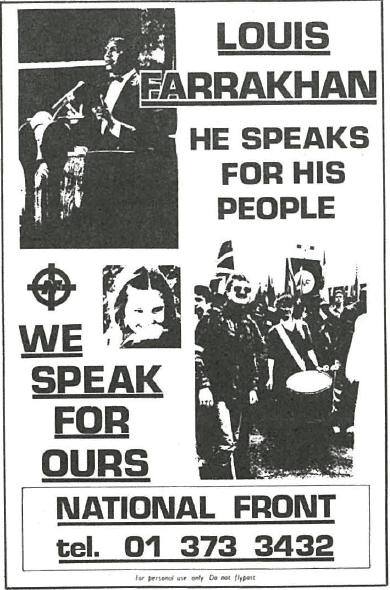
In 1986 the NF journal Nationalism Today published a five-page article by Wali Abdul Muhammad, Farrakhan’s righthand man.
The same year, Farrakhan applied to come to the UK. The proposed visit was highly controversial, and Searchlight argued forcefully in support of a ban subsequently imposed by Home Secretary Douglas Hurd on Farrakhan entering the country.
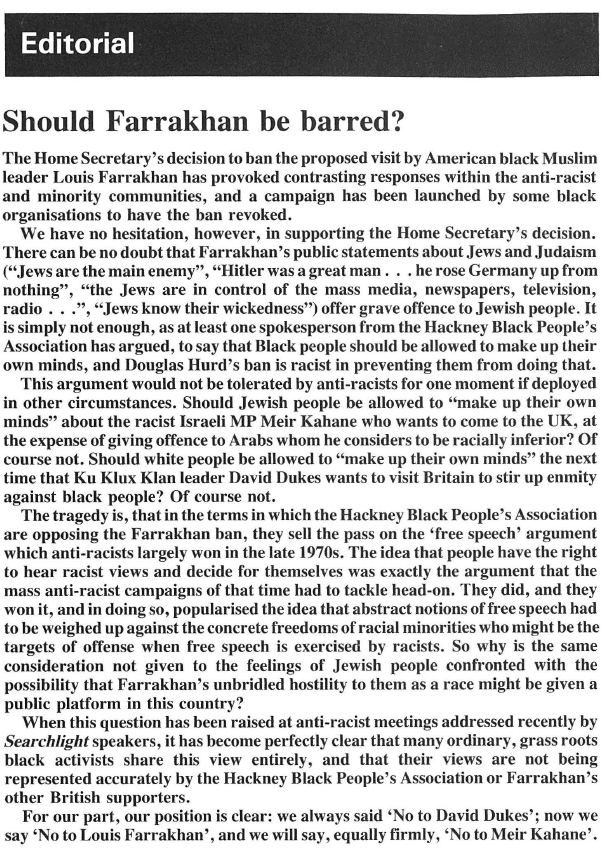
That ban still applies today, despite efforts to overturn it in 2001.
Then, when Griffin was on trial in London twelve years later for inciting racial hatred, he turned to Osiris Akkebala, who describes himself as a “Heirophant Spiritualist” and “Chief Elder of the Pan-African Inter-National Movement”, with the appropriate acronym PAIN.
Akkebala’s occult gobbledygook often allowed him to profit from associations with nazis and other white racists.
Holocaust denier
In 1996 he and a male friend got an expenses-paid holiday in London courtesy of Griffin and the Holocaust denier Ernst Zündel, who picked up the tab on Griffin’s behalf. The occasion was Griffin’s trial for inciting racial hatred, at which Akkebala appeared as a defence witness.
He testified that he did not find Griffin’s white supremacist literature offensive and regarded him as a “spiritual brother” united by a shared commitment to racial separation.
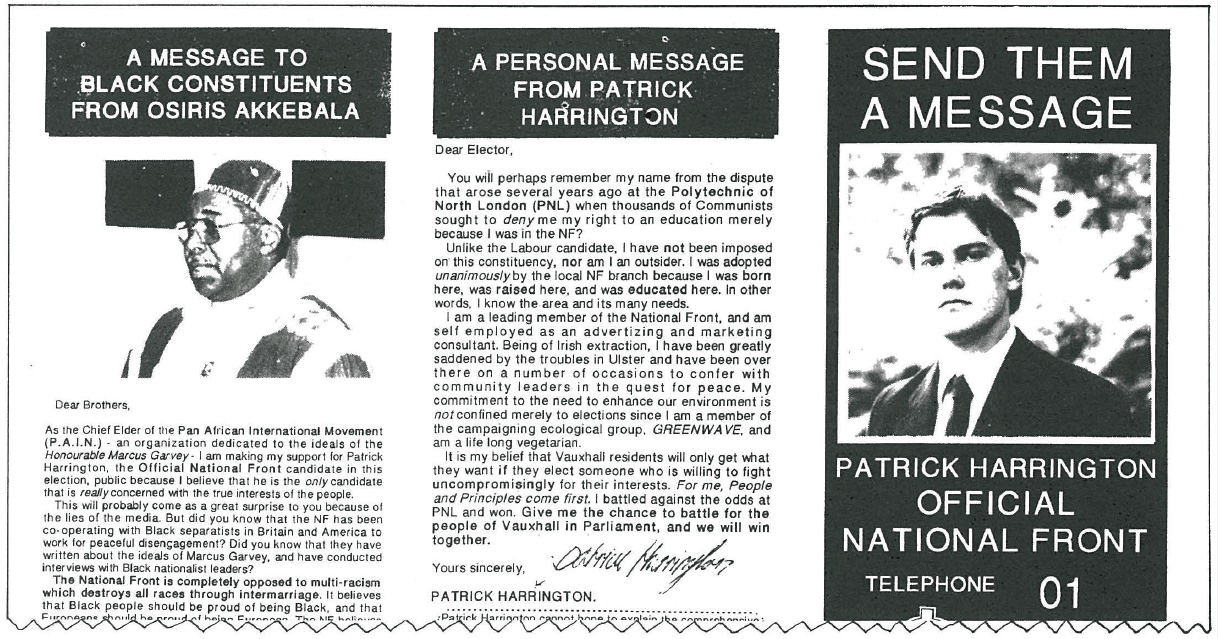
The connection dated back to 1988, when Akkebala followed Farrakhan’s example and allied with Griffin’s wing of the National Front.
A year later Akkebala endorsed Patrick Harrington’s campaign at the Vauxhall parliamentary by-election. His “message to black constituents” printed in NF leaflets included praising the Front for being “completely opposed to multi-racism which destroys all races through intermarriage.”
Vauxhall folk were unimpressed, giving Harrington a mere 127 votes (0.4%).
Ku Klux Klan
In 1992 the Florida-based Akkebala went on to form a joint campaign with John Baumgardner, leader of the Invisible Empire Ku Klux Klan. He also worked publicly with other violent racists including Tom Metzger, head of “White Aryan Resistance”.
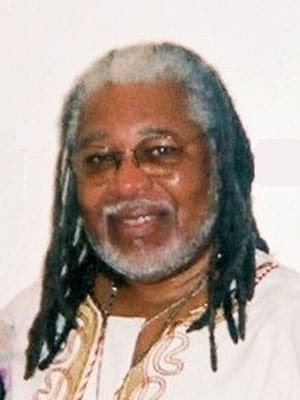
Now in his late 80s, Akkebala (who was born Jack Mitchell) no longer seems to be active. His political career started in Orlando during the 1970s when he was a candidate for mayor and city council, and he was an ordained Baptist minister before finding that he could make a better living as a “black separatist” and nazi collaborator.
Running through all of these associations was the notion that separatism, the insistence that the races must live apart, could unite Black nationalists and white supremacists.
The Black American community has produced many towering figures in the struggle against fascism – Paul Robeson among the greatest of them – and Black activists are even now in the vanguard of the struggle against Trump administration and his policies.
But it has also, occasionally, produced those who chose the opposite path.
The stories of Farrakhan and Akkebala sit at the fringes of Black political life, but they illustrate that separatist fantasies can create openings that fascists are quick to exploit.