Auschwitz survivor and lifelong anti-fascist campaigner Leon Greenman died on this day in 2008. This obituary, in Searchlight, was written by Julie Waterson, National Organiser of the Anti-Nazi League from 1992-2005, who herself sadly died in 2012.
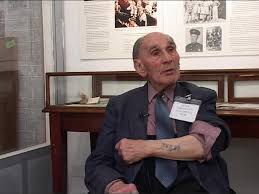
LEON GREENMAN 98288 – the only Englishman incarcerated in Auschwitz – has sadly died, aged 97. For over half a century he dedicated his life to Holocaust education and was passionate in his pursuit to tell the truth about the Nazi death camps.
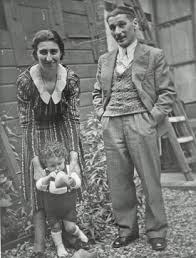
Leon Greenman with wife Esther and son Barnett, both of whom were murdered in Auschwitz
Emerging from Buchenwald’s liberation by the Americans in 1945, he entered mainstream life bearing the physical and mental scars of torture, beatings, imprisonment and hard labour.
His wife and son had been exterminated by the Nazis and he – eventually – returned to London with nothing but willpower and determination.
His strength was his conviction in humanity: Leon was confident that if people knew what happened in the camps, they would commit themselves to prevent a repetition of the Holocaust.
This belief took him to thousands of schools, colleges and conferences to speak to hundreds of thousands of people. For this he was awarded an OBE in 1998. In his words:
“Young and old alike must learn about the Holocaust as warning against the dangers of racism. There is no difference in colour or religion. If I had survived to betray the dead it would have been better not to survive. We must not forget. Please do not forget.”
Heavy price
Leon changed people’s lives with his words and that was his aim. For him, the camps and the fight against racism were not a history lesson: they were a battle today to prevent a repeat of history. For that he paid a heavy price. His home was attacked by nazis in 1994 and he endured death threats and hate mail for speaking to the press and for joining anti-nazi platforms. It made him even more determined to speak out.
It was that determination that helped him survive six concentration camps and a 60 mile death march. Yet, as a British citizen, he should never have been there. But, with no passport, he had no defence.
Leon had given his passport to a neighbour in Rotterdam for safety, as the Nazi invasion of the Netherlands in 1940 had restricted Jewish rights. When he asked for it back, it had been burned out of fear. He had pondered taking his wife Else back to Britain in 1938, but the Munich Agreement reassured him that they were safe.
Leon had lived in Rotterdam for most of his life and travelled to and from London as a bookseller. His five brothers and sisters lived in London, where he was born in 1910 in Whitechapel. He had trained as a barber, had aspirations to be a boxer and loved singing and entertaining people.
Living nightmare
Arriving as one of 700 Jews from the Netherlands in Auschwitz in October 1942, he waved to Else and two and a half year-old Barney, thinking he would be seeing them at the weekend. Along with others, he had no knowledge of the reality and it took him years to accept that his wife and son had been gassed and burnt in open pits. Leon was one of only two survivors from that shipment.
He endured a living nightmare in the camps, where the struggle for survival was paramount.
He owed his life to a Frenchman: he often spoke of him and wondered whether he had survived. The Nazis were losing the war and the prisoners were forced from camp to camp in a series of Death Marches. Leon was frozen and exhausted – the people who fell were shot – the Frenchman kept him upright and encouraged him to keep walking.
Vow to educate
It was during his recovery in a French hospital, that he took his vow to educate others. He faced a wall of silence: Britain in 1946 was radically different from the way it is now, with Holocaust Memorial Day and a national curriculum that educates every schoolchild about the Holocaust.
These are the result of the work people such as Leon undertook for decades: the survivors who could tell the truth. Since 1995, the Jewish Museum has hosted a permanent exhibition of Leon’s life and experience and he was to be found there every Sunday, willing to talk to anyone.
Leon Greenman – lifelong campaigner against fascism
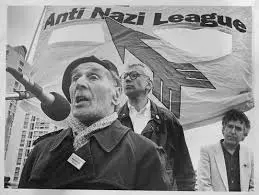
Up until very recently, he attended any protest or demonstration against the growth of the far right in Britain. He was comparing tattoos with Pete Doherty at the Love Music Hate Racism gig in Trafalgar Square in 2004! When the far right were entering mainstream political society in the early 1990s, Leon was at the forefront of the struggle to stop them.
He was an active supporter and recruiter for the Anti Nazi League and Unite Against Fascism.
Leon has left us a legacy and his death has robbed us of a very powerful weapon in the battle to marginalise those who deny his life and experiences.
About the author
The Searchlight team investigates and opposes fascism, antisemitism and racism in Britain and abroad, and has been doing since 1964
Today's Top Ten most popular reads
What people are saying about Searchlight
Peter Hain
British Jews have been persecuted over the centuries; British blacks since the Windrush generation of the 1950s; British Muslims, especially after the Islamist 9/11 and then 7/7 terrorist attacks in New York 2001 and London 2005. But until the last few years there has not been a simultaneous threat against all three British communities of Jewish, Black and Muslim Britons – meaning the need for Searchlight has never been greater.
Peter Hain
Labour peer, former MP and Cabinet Minster
Paul Holborow
In the campaign against the National Front, Searchlight provided a rich and utterly reliable basis for much ANL propaganda – particularly with reference to the two leading NF figures, John Tyndall and Martin Webster. The appearance of Tyndall in full nazi uniform, drawn from the archives of Searchlight, was a key part of ANL propaganda, coupled with deeply damaging nazi quotes from Webster.
Paul Holborow
Founding member of the ANL and National Organiser 1977-81
Nick Davies
To investigate fascists takes real courage and unusual commitment. The government, police, mainstream media occasionally take a look, but in the UK only Searchlight have kept at it, relentlessly and admirably, regardless of threat or obstacle. It’s journalism that matters. A rare thing.
Nick Davies
Multi-award-winning investigative journalist and writer
Paul Nowak
The essence of trade unionism is solidarity, fairness and equality – for all workers – from all backgrounds. That’s why our fight against the far-right has always been part of our movement’s DNA. Searchlight is an incredibly important resource for trade unions and members to understand the contemporary tactics of far-right activity. Their work and intelligence gathering over the years have been incredibly insightful for the work we do, and how we fight the scourge of fascism.
Paul Nowak
TUC General Secretary
Alf Dubs
Searchlight’s voice is more important than ever, and I am delighted that it will now be available to a wider audience than ever before in its new incarnation online. Searchlight has been extremely helpful over the years in exposing the far right, corruption, criminality and the murky links between organised crime and powerful interests in the UK and abroad. I wish Searchlight the very best.
Alf Dubs
Labour peer, former MP and Cabinet Minister, and Kindertransport child
Professor Colin Holmes
Everyone who wants to understand contemporary racism and its historical background needs to read Searchlight.