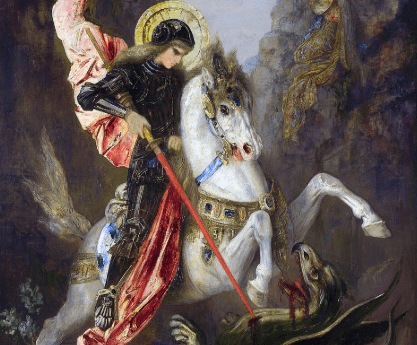
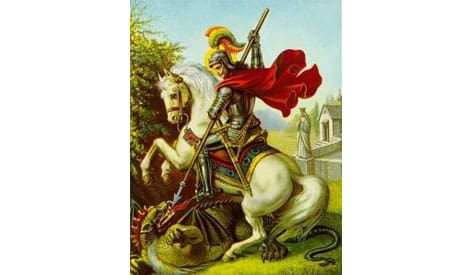
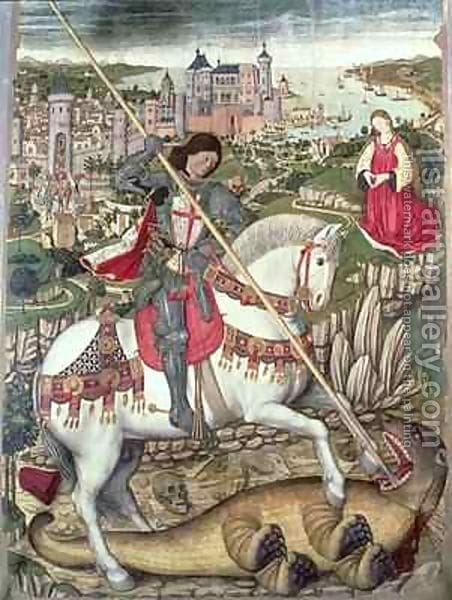
Every April, on this day, England celebrates its patron saint: a dragon-slaying hero on a white horse, his red cross flying from flagpoles across the nation. For many, Saint George is the ultimate symbol of Englishness. There’s just one problem: almost everything about him is foreign.
Far from being an English knight, George was a Greek-speaking Roman soldier born in Cappadocia, in what is now modern-day Turkey, to a Greek father and a mother from Palestine. He never once set foot on English soil. In fact, England wasn’t even Christian when he lived.
Medieval chivalry
The connection arose centuries later, when crusading kings adopted him as a patron because he embodied the ideals of medieval chivalry, not because he had any ancestral ties to the British Isles.
Where George truly belongs is not in a rainy northern kingdom but in the sun-baked eastern Mediterranean, where he is revered across religious lines in a way that defies modern sectarianism. Throughout the Levant, Saint George is venerated not only by Christians but also by Muslims, Druze, and even Jews.
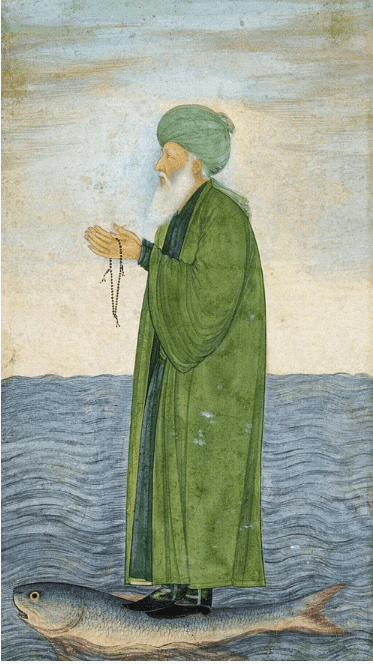
Muslims often identify him with the mysterious figure of al-Khidr, the “Green One”, a guide mentioned in the Qur’an who grants wisdom and is associated with spring rains, healing, and fertility.
In places like the Palestinian village of al-Khadr (literally “the Green”), Muslims and Christians celebrate his feast day together on May 5th, praying at shared shrines and seeking cures for infertility and illness.
Military saints
The Druze, meanwhile, regard Saint George (or Mar Girgis) as one of their most esteemed non-Druze holy figures, often syncretizing him with al-Khidr and even identifying him with the prophet Elijah (Mar Elias).
For them, he forms a trinity of military saints alongside Saint Michael and Elijah himself, defending the true faith across confessional boundaries.
Even in Jewish folk tradition, Saint George, alongside Elijah and al-Khidr, was jointly venerated by agricultural communities across the Levant, where all three figures were associated with rain, greenness, and storms.
In other words, the man held up today by English nationalists as a symbol of insular English identity is, in his true homeland, a figure of shared devotion among Christians, Muslims, Druze, and Jews, a walking refutation of the idea that faith and culture must be kept separate.
Awkward symbol
And this is precisely why Saint George is such an awkward symbol for Britain’s far-right. Over the past several decades, the St George’s Cross has been increasingly co-opted by xenophobic and racist groups who use it to intimidate immigrants, protest multiculturalism, and demand “purity”.
But the saint they invoke has literally nothing to do with their cause.
He was a Middle Eastern immigrant. Born in Turkey to a Palestinian mother, George spent his life in the Roman provinces of Asia Minor and Palestine. He was, by any modern definition, a person of color from the eastern Mediterranean.
If he applied for a visa to today’s Britain, he would likely face the kind of hostile immigration system his would-be champions demand.
Resistance to empire
His faith was forged in resistance to empire. George was not a nationalist but a rebel. He rose through the ranks of the Roman army only to publicly defy the emperor Diocletian’s persecution of Christians, refusing to renounce his beliefs and paying for it with his life.
He was executed for opposing state tyranny – hardly the poster child for authoritarian nationalism.

He belongs to everyone, not just England. George is the patron saint not only of England but also of Ethiopia, Georgia, Portugal, Lithuania, Palestine, Serbia, and the cities of Moscow, Beirut, and Genoa.
His flag was once considered a symbol of multicultural Britain precisely because it avoided the colonial baggage of the Union Jack. Far from being an emblem of ethnic purity, the St George’s Cross was historically seen as representing a “multi-ethnic Britain”, and many faith groups have explicitly called for reclaiming it from the far right as a symbol of inclusivity rather than hatred.
No blue-eyed knight
The real Saint George is not a blue-eyed knight from a fairy tale but a Greek-speaking soldier born in Turkey to a Palestinian mother, executed by the Roman Empire, and venerated for centuries by Muslims, Christians, Jews, and Druze alike.
He has never had anything to do with English nationalism, racial purity, or anti-immigrant sentiment, and everything to do with the shared spiritual heritage of the eastern Mediterranean; a foreigner, a rebel, and a bridge between faiths.