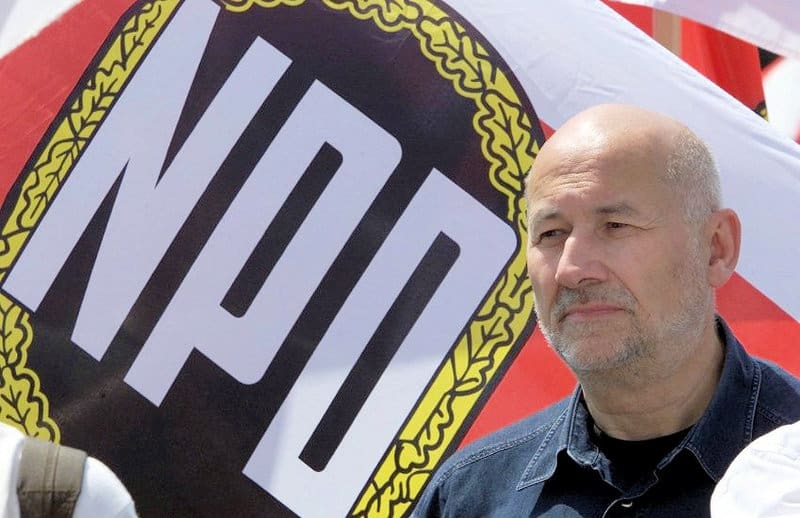
German security forces are on alert after the death of Horst Mahler, the Baader-Meinhof terrorist who became one of Europe’s most poisonous antisemites.
Mahler was for years the intellectual godfather for Germany’s most violent nazis, some of whom are already facing trial accused of terrorist offences, coup plots and assassination plans.
There are fears his death could trigger violent crimes as a tribute to this former lawyer who became a Holocaust denier, noted for his increasingly crazed attacks on Jews, whom he viewed as “Satanic”.
Escape plan unravelled
On Hitler’s birthday in 2017, Mahler’s nazi fan club arranged for him to escape a prison sentence by driving him across the border to Hungary where he sought political asylum.
But this nazi plan unravelled (as Searchlight editor Gerry Gable wrote at the time) because the Hungarian government had recently turned against the various nazis and racists (ranging from Nick Griffin to Jared Taylor) who had been using their country as a flag of convenience.
Mahler was swiftly sent back to Germany and was safely locked up for another three years.
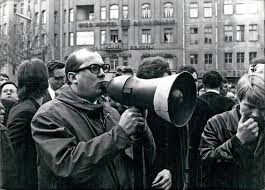
His first prison sentence was a fourteen-year stretch in 1970 for bank robbery and terrorism on behalf of his friends and protégés in the Baader Meinhof group, also known as the Red Army Faction.
Mahler served ten of those fourteen years, and though allowed to resume his legal practice he spent most of the 1980s and 1990s moving to the far right, eventually as one of Germany’s most notorious nazis.
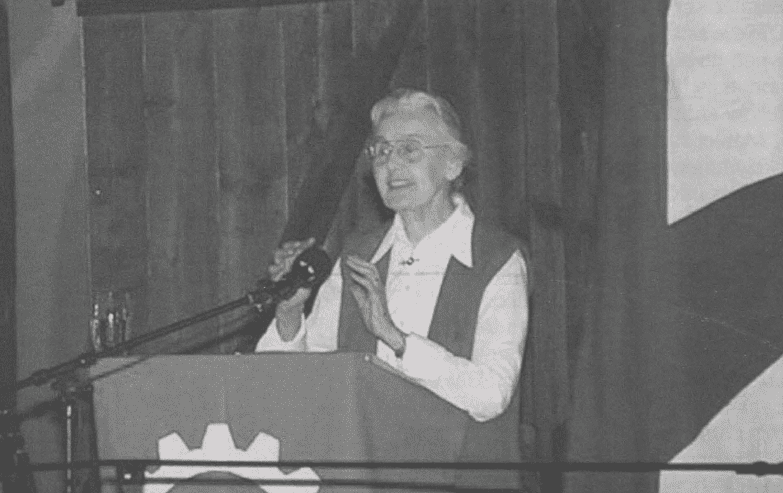
For the past 25 years Mahler has been at the forefront of Holocaust denial. His death aged 89, eight months after his even older fellow conspirator Ursula Haverbeck shuffled off to Valhalla, leaves the geriatric David Irving as the last living representative of that older generation on the denial scene.
Holocaust denial
At 87 and seriously unwell, David Irving has long been incapable of work, but his family continue to reissue his books and videos hoping to extract further cash from his nazi fan club.
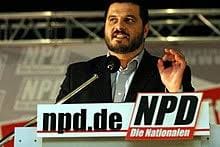
For a few years in the early 2000s Mahler was a lawyer for Germany’s leading postwar nazi party NPD, and with his fellow lawyer Jürgen Rieger he was part of a group of extreme hardliners who tried to ground the party firmly in national socialism and prevent it from “liberalising”.
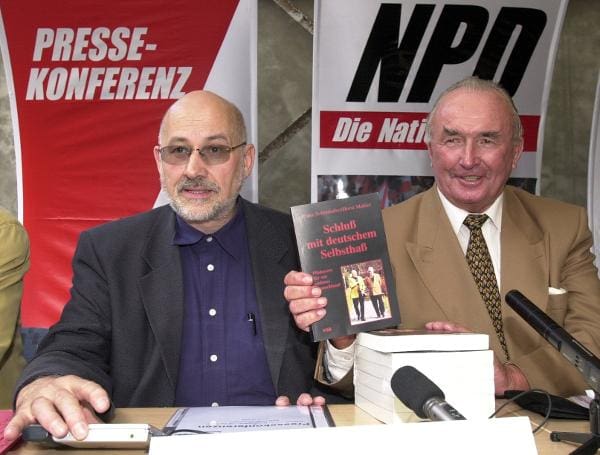
Another leading figure in that process was Udo Voigt, a former officer in the postwar Luftwaffe who was NPD leader for fifteen years. Voigt, a far less intellectual figure than Mahler or Rieger, also died earlier this month, aged 73.
Conspiracy cult
Mahler quickly gave up party politics and worked instead with fanatics even further to the nazi fringe than the NPD. These included a much younger lawyer Sylvia Stolz, who for several years was Mahler’s mistress before he went back to his wife, and a weird Swiss-based cult led by the conspiracy theorist Ivo Sasek.
Another leading figure in this scene is Bernhard Schaub, a Swiss-German holocaust denier who led “European Action”, a gang that was swiftly banned for terrorism but which included the late BNP national organiser Richard Edmonds.

Schaub is one of the Mahler fan club involved in German coup plots and secretive training camps, though he is persona non grata in some of these circles due to having seduced the young daughter of a fellow activist.
After the rise of the more “respectable” AfD, the NPD went into a rapid decline and almost all of its members chose to abandon even the party name.
British nazis
They reorganised under the label “Heimat”, which was one of several tiny movements that were among the first to announce Mahler’s death.
Heimat’s best known spokesman is the former NPD deputy leader Sascha Rossmüller, who has built connections with British nazis in various factions including Nick Griffin, Mark Collett of Patriotic Alternative, and Mark Cotterill of Heritage and Destiny.
Cotterill’s magazine was the first British outlet to publish an obituary tribute to Mahler yesterday.
Mahler’s political odyssey included association with Palestinian terrorists who (on instructions from the East German intelligence service) were happy to train both Marxists (as Mahler then was) and nazis (as he later became).
By the 21st century he was pursuing the same antisemitic agenda, but this time with new Middle Eastern allies. In 2006 he tried to attend a Holocaust denial conference in Tehran organised by Iranian President Mahmoud Ahmadinejad, but the regional authorities in his home state of Brandenburg spoiled his plan by confiscating his passport.

Mahler was close to several of those who did attend and speak at this Tehran event, including London’s high society antisemite Lady Michèle Renouf and the pope of Holocaust denial, disgraced French professor Robert Faurisson.
For the last twenty years of his life the former lawyer Mahler became increasingly enraged and determined to incite young Germans to revolutionary violence.
His own efforts led to spending about twenty years of his life in jail, and further years on the run or facing trial. And he was keen to ensure that more of his fellow countrymen followed suit, whether by unleashing terrorist campaigns against democracy, killing Jews, or simply wasting their own lives.