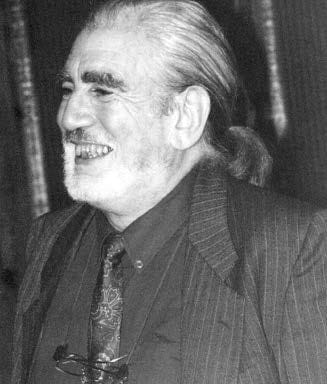
Mike Cohen was one of Britain’s great Jewish anti-fascists, whose significant contribution to the movement came through his camera lens.
He passed away in October 2002 at the age of 67, and with the passage of time I often think of Mike, convinced that he deserves to be remembered.
Mike came from a time when proud Jewish anti-fascists were at the core of the movement and often the wider left.
The making of an activist
Mike was born into a Jewish East End of London family and like many young Jews of his time was apprenticed into the tailoring industry.
He was a lifelong socialist, starting out as an activist in the youth section of Poale Zion which led him to work in Israel as a volunteer on a kibbutz in the early 1950s and on a power station.
Military service
Back in England Mike was called up for compulsory military service and to his horror found that he was to be posted to Germany.
He had lost family in the Holocaust and really did not want to be there. Despite his pleas to be posted elsewhere he was stationed there anyway.
It turned out the Germans were to be the least of his problems. He faced considerable antisemitism from his fellow soldiers, it was a miserable time, although there were also people who physically defended him.
Mike was called up for compulsory military service and to his horror found that he was to be posted to Germany. He had lost family in the Holocaust and really did not want to be there.
Both the miserable experience of antisemitism and the fact that there were also allies was something that stayed with him.
Upon his discharge, Mike left that dark chapter behind to pursue his education and further activism. He enrolled at the London School of Economics and went on to become a social worker, working with the homeless and mentally ill.
Later, Mike ran an old people’s home for Camden Council in north London. For much of that time he was a member of Hampstead Labour Party but didn’t remain a member and for the rest of his life he was a non-aligned socialist.
The 62 Group and the founding of Searchlight
Mike was active in the Campaign for Nuclear Disarmament and it was on their annual Aldermaston march in 1963 that he first met fellow anti-fascist Gerry Gable.
The march was attacked by fascists. They were part of the group who physically overturned a fascists’ car in one clash.
Gerry and Mike worked together after that doing intelligence gathering for the anti-fascist 62 Group and then went on to found the anti-fascist organisation Searchlight together.
Professional approach
As a 62 Group activist Mike was arrested on at least two occasions. In 1964 he was arrested at Kerbella Street when he helped break through the police line and chase John Tyndall and his Greater Britain Movement off the streets.
Another time he was arrested for attempting to break into a print shop in Stoke Newington that was printing fascist material.
Professional approach
Sometime in the late 1960s a core group of 62 Group activists decided that their sometimes comically amateur – albeit successful – activities needed a more professional approach.
They all learnt some self-defence – they were invariably pretty handy in a fight anyway – but they were also each given a specific skill. And that is how Mike became trained as a photographer.
Gerry and Mike worked together after that doing intelligence gathering for the anti-fascist 62 Group and then went on to found the anti-fascist organisation Searchlight together.
Mike was much more than a single issue anti-fascist. He was active in the squatter’s movement and assisted arrested members of the Angry Brigade out of principle – although he did not share their politics – the anarchist urban guerrilla group responsible for a series of small-scale bombings and armed actions against the establishment in the early 1970s.
Mike was renowned for how game he was when out taking pictures and was at some of the most significant events of his time.
Trampled by a police horse
He was at Red Lion Square when the police violently assaulted protestors in 1974 at the demonstration against National Front.
He was also at the Wapping print strike picket line when a Morning Star photographer was trampled by a police horse and dived in to rescue him from further injury.
He also took pictures of the Greenham Women’s Peace Camp and remained in contact with activists from there.
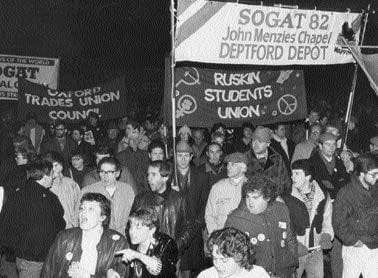
My first memory of Mike is from some time in 1987 or 1988 when as a teenage volunteer with Searchlight Gerry Gable sent me to meet him.
We had found out that one of the small fascist groups – they were all small back then – had booked a room somewhere and we wanted to secretly photograph the event.
The only way to do that was to do a recce beforehand and see the layout of the place and work out where to be positioned on the day.
Charm offensive
Mike had it all planned out. “I’ll do the talking and you follow my lead,” he said as he handed me an enamel Labour Party badge to put on my jacket and put another one on his.
He then knocked on the door of the venue and issued a charm offensive on the poor chap we were lying to, who was showing us around, on what a marvellous place this would be for local Labour Party meetings.
“Do you think this room would be the right size for our meetings,” he asked me as we made mental notes of where everything was and where best to be positioned for taking photos surreptitiously a few days later.
Black and white
Whenever there was a fascist gathering Mike was invariably there shooting black and white photos for Searchlight. Searchlight magazine was printed in black and white in those days, and that was what was needed.
Except printing photographs in black and white meant that the photos had to go through a laborious development process.
Whenever there was a fascist gathering Mike was invariably there shooting black and white photos for Searchlight.
I used to have to sit in Mike’s kitchen in his flat in Hackney, which he had modified so that it could be totally blacked out as a dark room, while the film went through the chemical process and eventually pictures emerged at the other end.
Over the years I spent a lot of time with Mike. When he was holding his camera taking pictures of fascists it was often necessary to keep an eye on him as when he held a camera up he couldn’t see what was going on around him.
“Every time I take a picture of one of these bastards I feel like I am shooting them with a gun,” Mike liked to say. On at least one occasion a fascist spotted him and shouted “I suppose we are gonna be in Searchlight in next month.”
Will we ever see his like again?
Mike was an unassuming man, and like many of his 62 Group comrades rarely boastful of the gung-ho activities that he had been involved in. Invariably it would come out through a story he would be telling you about someone else, but as the story grew you realised he was also there.
In later years Mike devoted himself solely to taking photos, from which he barely eked out a living. His pictures were mostly published in three publications: Searchlight, The Morning Star and the New Worker.
Under his wing
At Mike’s funeral I was asked to say a few words on the influence he had on younger anti-fascists. I had known him all my adult life and learnt as much from him as any other of that older generation of 62 Group anti-fascists that had taken me under their wing.
I don’t recall what I said but I have an abiding memory of something. It isn’t uncommon for a coffin to be draped in a flag, but Mike’s was draped in two.
Mike may have been an unaligned socialist but his comrades were very much aligned. His Jewish 62 Group comrades draped it in an Israeli flag representing his Jewish background and roots and his communist comrades in a Soviet flag representing his lifelong commitment to socialism.
I often wonder, particularly in these hardest of times for Jewish anti-fascists, whether I will ever see the likes of that again.
This article first appeared in Steve Silver’s blog, Leaden Skies where he writes about fascism, antisemitisim and racial hatred. You can find it here